There are some experiences that look incredible on screen. And there are others that can only be understood in person.
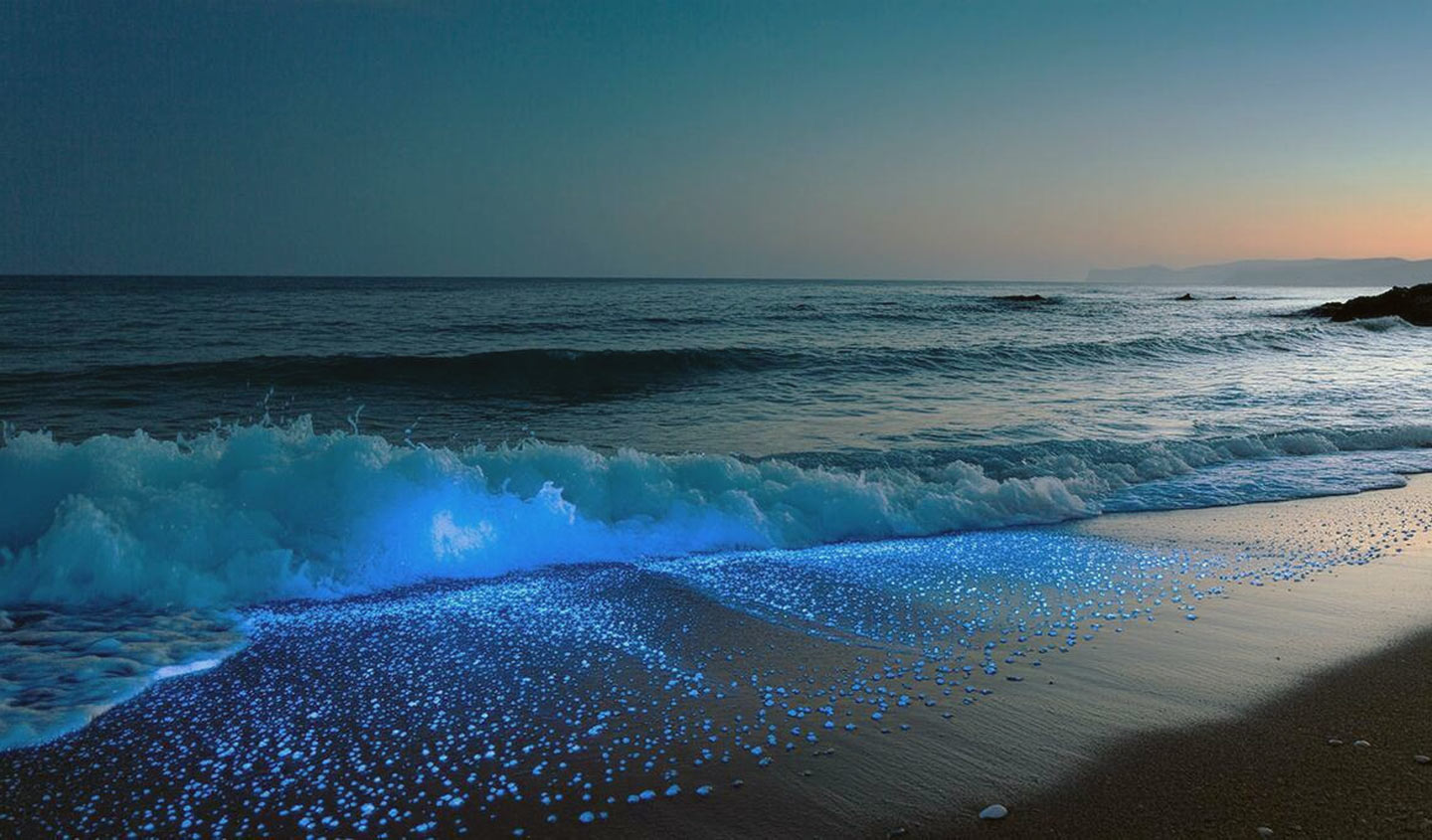
Bioluminescent kayaking on Tomales Bay falls squarely into the second category. As darkness settles in, millions of microscopic organisms light up the water with every paddle stroke, creating an almost unbelievable display of electric blue beneath the night sky.
By now, you may be wondering: Couldn’t I just pull up a YouTube video? Is it really that different in person?
It’s a fair question. As an avid YouTube watcher myself, I spend hours watching DIY projects, interviews, travel videos, home repairs, and just about everything in between. Video is an incredible way to learn, discover, and experience places from afar.
But it’s not a one-to-one replacement.
So yes, I could send you a YouTube video. You’d see the same glowing water. You’d understand what it looks like. I could even describe the way the bay sparkles around you, as if someone scattered stars across the surface of the sea.
But to answer your question.
Yes, it really is that different in person.
Because a video only lets you see it.
Being there lets you feel it.
Because a video can’t recreate the silence that settles over the water. It can’t capture the slight resistance of your paddle, or what it’s like to trail your hand through the sea and feel millions of tiny organisms drift between your fingers, each one lighting up for just an instant before disappearing back into the darkness.
That’s something you can only understand by being there. It’s like what the late, great Robin Williams said in Good Will Hunting:
“If I asked you about art, you’d probably give me the skinny on every art book ever written. Michelangelo, you know a lot about him. Life’s work, political aspirations, him and the pope, sexual orientations, the whole works, right? But I’ll bet you can’t tell me what it smells like in the Sistine Chapel. You’ve never actually stood there and looked up at that beautiful ceiling.”
And that’s the beauty of travel. It isn’t just about seeing remarkable places or checking destinations off your bucket list. It’s about the moments that stay with you long after you return home: the aroma of an unexpected meal, the view from your bedroom window, the feeling of ancient stone beneath your fingertips, or the glow of millions of tiny organisms as your paddle hits the water.
So, if you’d like, here’s that YouTube video of the bioluminescent kayaking ride.
But something tells me you’d rather experience it for yourself.
When I was a sophomore in college, I had a history professor who completely changed the way I thought about the subject.
Most history classes felt like an endless list of dates, names, and facts you were expected to memorize just long enough to survive a test. His classes felt more like episodes of a really good TV drama.
He told stories. Not “history stories.” Human stories. And we, his students, found ourselves binging world history decades before binging became a thing.
In his classroom, kings, generals, politicians, and ordinary people weren’t names in a textbook. They were characters. They had flaws. They succeeded. They failed. They loved. They worried. And many times, they made spectacularly bad choices.
History wasn’t something that happened. It was something people lived through.
For our final research paper, he gave us an assignment I’ve never forgotten. We had to write in the first person, using actual historical sources, and tell a story. I chose to write from the perspective of a Roman soldier stationed in Pompeii during the eruption of Mount Vesuvius.
Spoiler alert: I didn’t survive. But I did get an A on the paper. (I’m pretty sure I still have it somewhere.)
More importantly, I developed a fascination with Pompeii that stuck with me long after the semester ended.
THE PLACE I NEVER THOUGHT I’D SEE
For years, Pompeii existed only in books, documentaries, and my imagination. Then, about fifteen years later, my wife and I found ourselves in Rome on our honeymoon. We decided to take a day trip south.
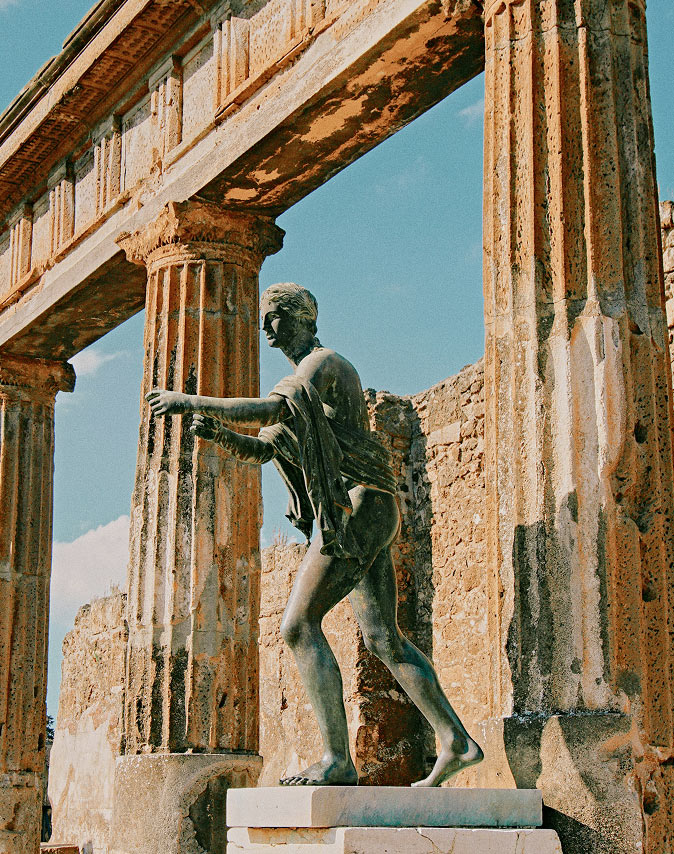
Suddenly, I wasn’t reading about Pompeii anymore. I was standing in it. And it was every bit as incredible as I hoped it would be.
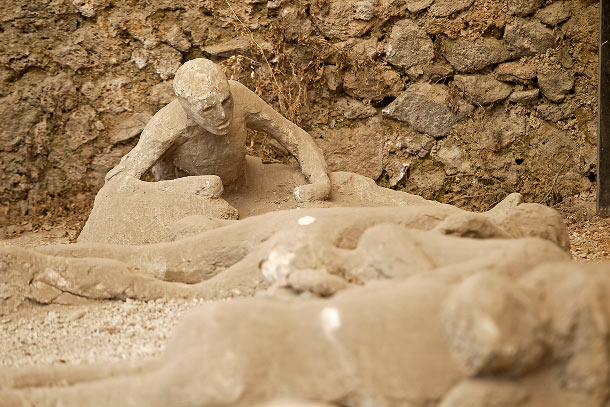
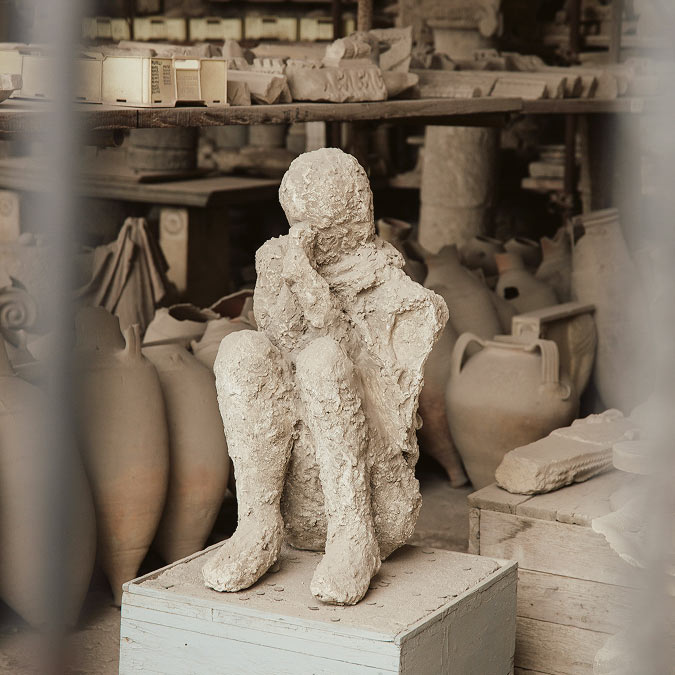
What’s funny is that when people talk about Pompeii, they usually focus on one thing: the casts. Those haunting figures frozen in time. They’re remarkable, of course. And seeing them in person is powerful. But they’re not what I remember most.
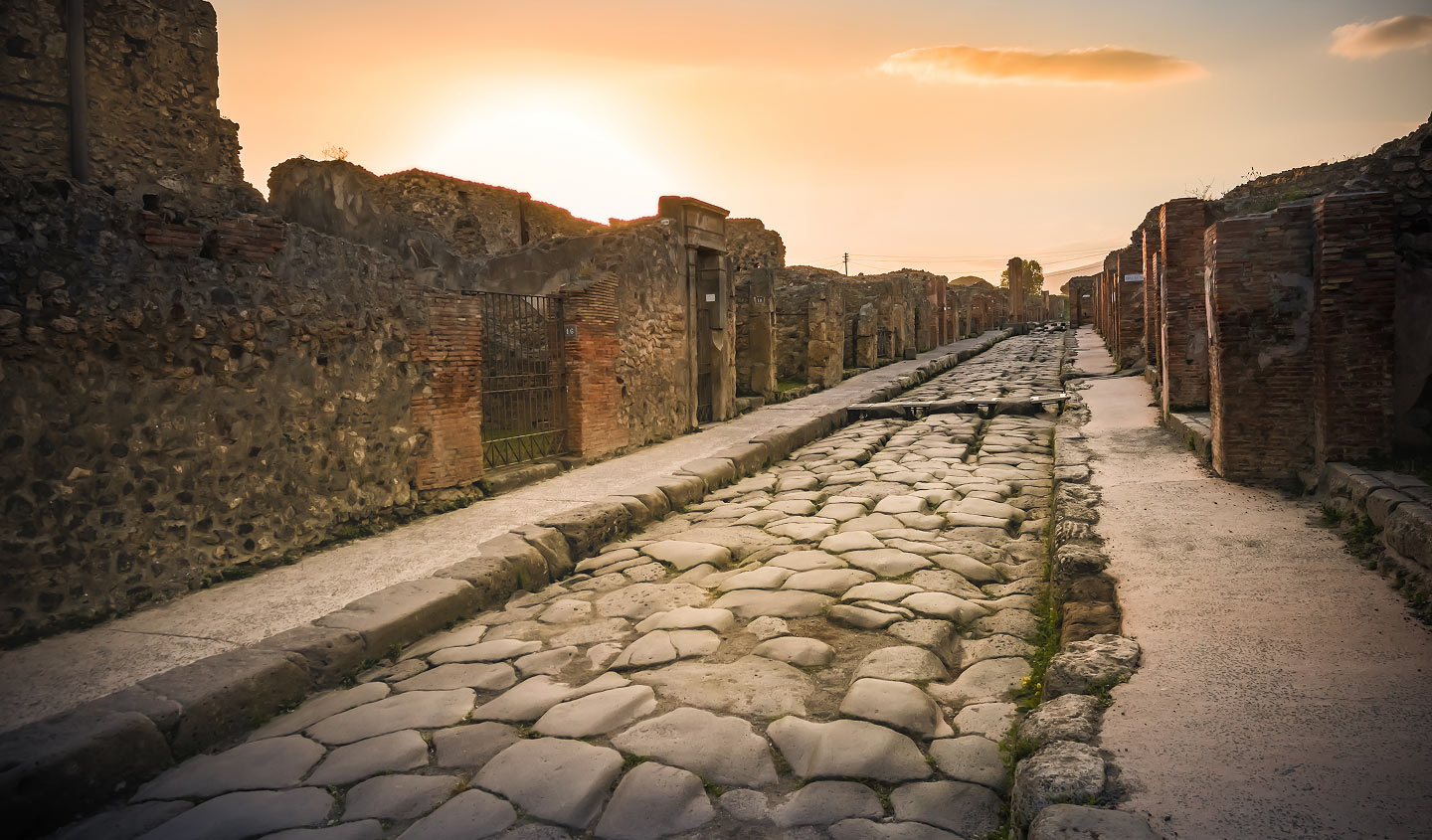
I remember the deep wagon-wheel ruts carved into stone streets by generations of traffic.
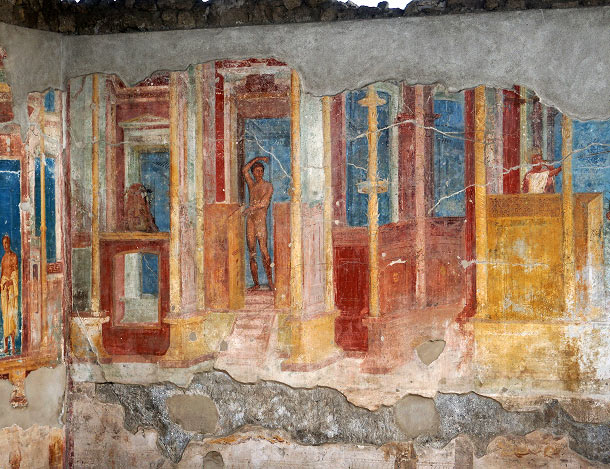
I remember faded paintings that somehow still cling to walls after nearly two thousand years.
I remember standing where gladiators once trained.
I remember walking through homes and courtyards and realizing that, despite all the centuries between us, the people who lived here weren’t all that different from me.
And I remember Mount Vesuvius. You can see it from just about everywhere. And even now, it feels like it’s watching.
THE STORY MOST PEOPLE DON’T KNOW
Here’s something many visitors don’t realize.
Those famous figures aren’t actually people turned to stone. When Vesuvius erupted in 79 AD, the city – and thousands of its inhabitants – were buried beneath volcanic ash and debris. Over time, the bodies of the victims decomposed, leaving hollow spaces in the hardened ash. Centuries later, archaeologists discovered these voids and carefully filled them with plaster.
What we see today are casts of the spaces people once occupied.
Not the people themselves, but the traces they left behind.
In a strange way, I think that’s even more moving.
LOOKING BEYOND THE SPECTACLE
Pompeii attracts millions of visitors every year. And understandably so. It’s one of the most extraordinary archaeological sites on Earth.
But it’s also easy to reduce it to a spectacle. To focus on the eruption. The tragedy. The dramatic final moments.
The longer you spend there, though, the more you realize that the real story isn’t how Pompeii ended. It’s how Pompeii lived.
The bakery where bread was made. The shops that opened each morning. The homes filled with artwork. The streets crowded with merchants, workers, travelers, and children.
The details are what make Pompeii feel surprisingly emotional. They’re familiar.
History often feels distant because we focus on what makes people different from us. But, when you’re there, Pompeii reminds us how much we actually have in common.
A STORY THAT ISN’T FINISHED YET
One of the most fascinating things about Pompeii is that archaeologists are still uncovering new pieces of the city today.
The story isn’t finished.
On Roam by Tauck’s Rome, Sicily & Malta journey, guests have the rare opportunity to go beyond the areas most visitors see and step into a restricted active excavation zone, where new discoveries continue to emerge from beneath the ash, helping historians better understand what everyday life looked like before the eruption.
It’s a chance to see history while it’s still being revealed. And, for someone who has been fascinated by this place since a college history class decades ago, that’s pretty incredible to think about.
THE TRACES WE LEAVE BEHIND
While I was thinking about what to write for this post and doing a little research, I found myself trying to remember the name of that professor. I’m ashamed to say I couldn’t.
But I did come across an old university article about a beloved history professor who passed away just a few years after I took that class.
I can’t say with complete certainty that it was him. But some details line up in a way that makes me think it probably was. (I actually ordered my transcript to find out for sure – but unfortunately it doesn’t show professors’ names.)
If that’s true, it’s strange to realize that someone whose name had slipped from my memory still managed to shape the way I experience places like Pompeii all these years later.
And maybe that’s why Pompeii still matters.
We don’t know the names of most of the people who lived there. We don’t know what made them laugh. We don’t know what they talked about at dinner.
We don’t know what they planned to do on a tomorrow that never came.
But pieces of them remain. A painting on a wall. A groove in a road. A loaf of bread preserved in ash. A home they loved.
Enough to remind us they were here. Enough to make them impossible to forget.
Professor, I hope you’re resting easy. I wish you could know what an impact your class and that assignment had on me. It was one of the first times I realized I might be able to turn this whole writing thing into a real career. Wherever you are now, just know that your story – like all those stories you told us years ago – lives on.
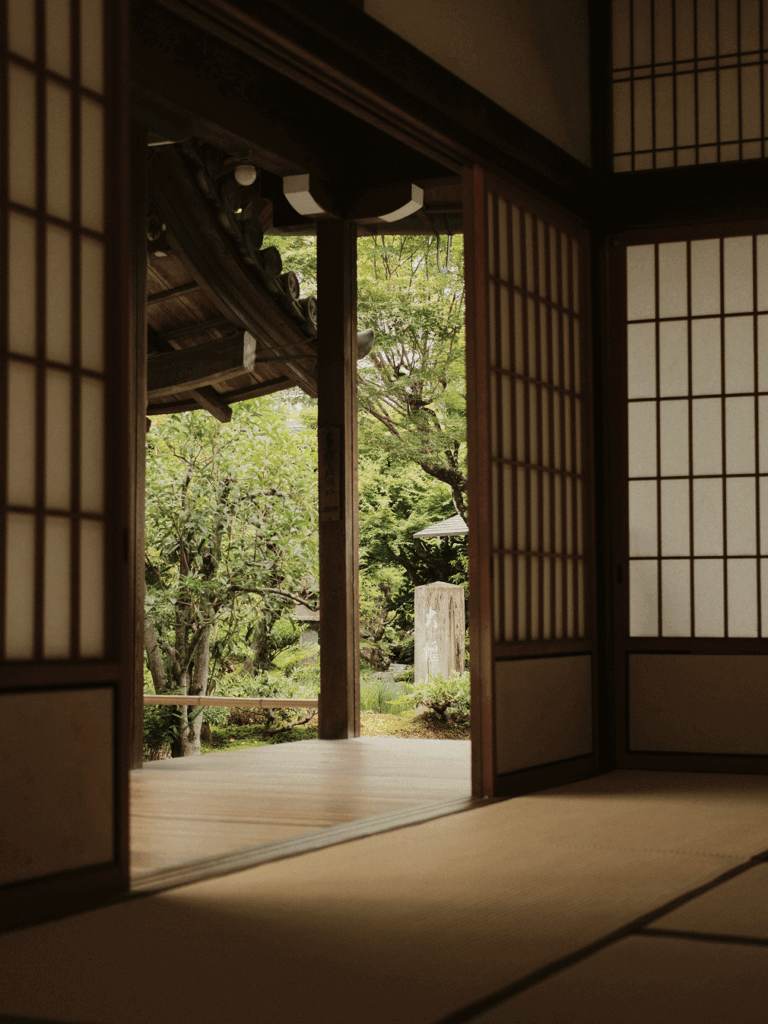
Tokyo pulls you in at full speed with its neon reflections, packed train platforms and ramen counters still humming with life well past midnight, while Kyoto carries its history more quietly through incense-filled temple courtyards and narrow streets where centuries-old traditions still shape daily life. Osaka moves with a rhythm entirely its own too, vibrant, electric, and expressively alive.
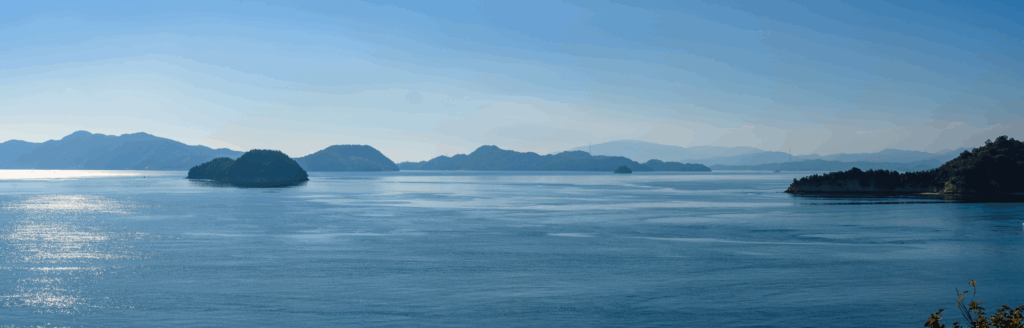
And then there’s the Seto Inland Sea, where everything seems to exhale. The way island life tends to do.
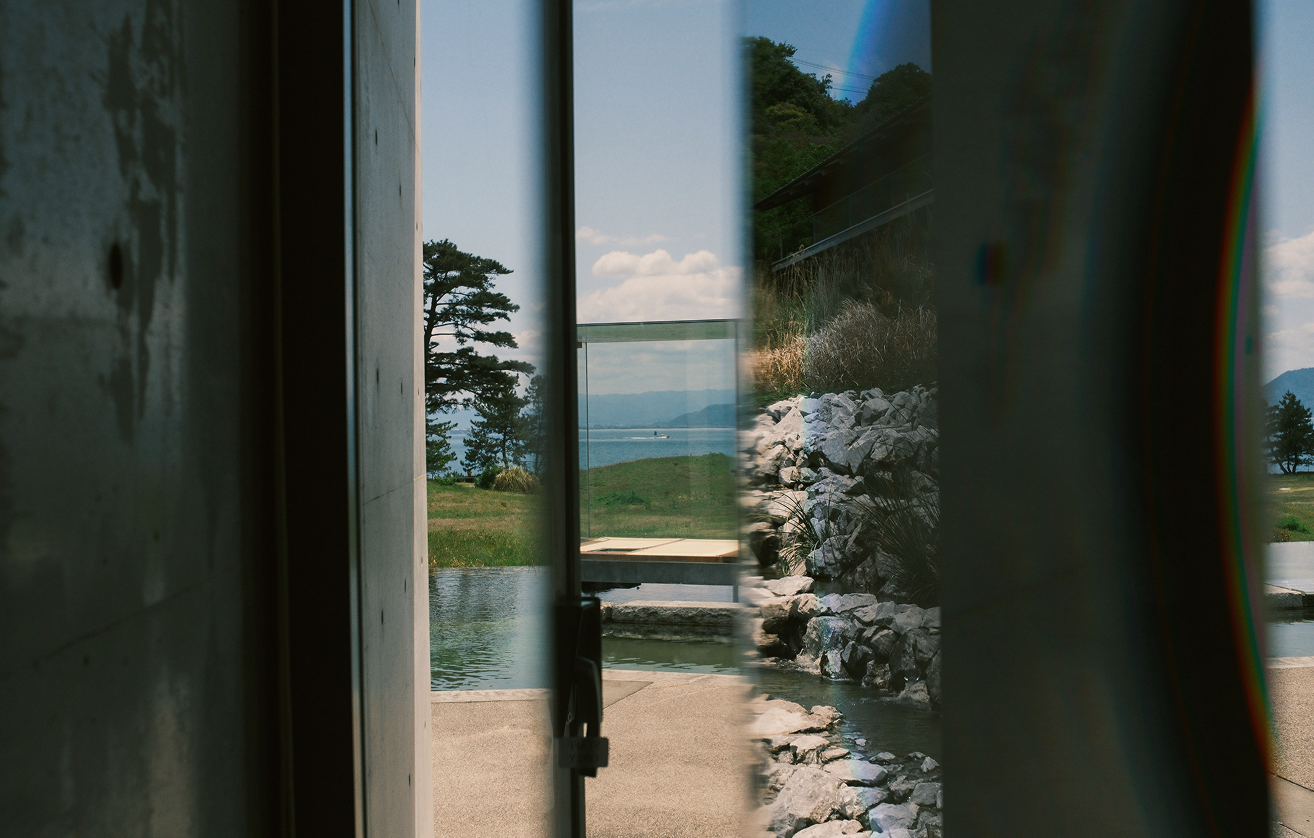
Stretching between Honshu, Shikoku and Kyushu, this network of islands and coastal towns feels worlds away from the velocity of modern travel. Ferries drift across glassy water. Fishing villages wake with the tide. Contemporary art museums rise from forested hillsides so naturally they seem part of the landscape itself. Even time appears to soften around the edges here.
That slower rhythm is exactly what makes the region feel so compelling right now.
Because for a growing generation of travelers, the goal is no longer simply to see everything. It’s to feel something a little bit more while you’re there.
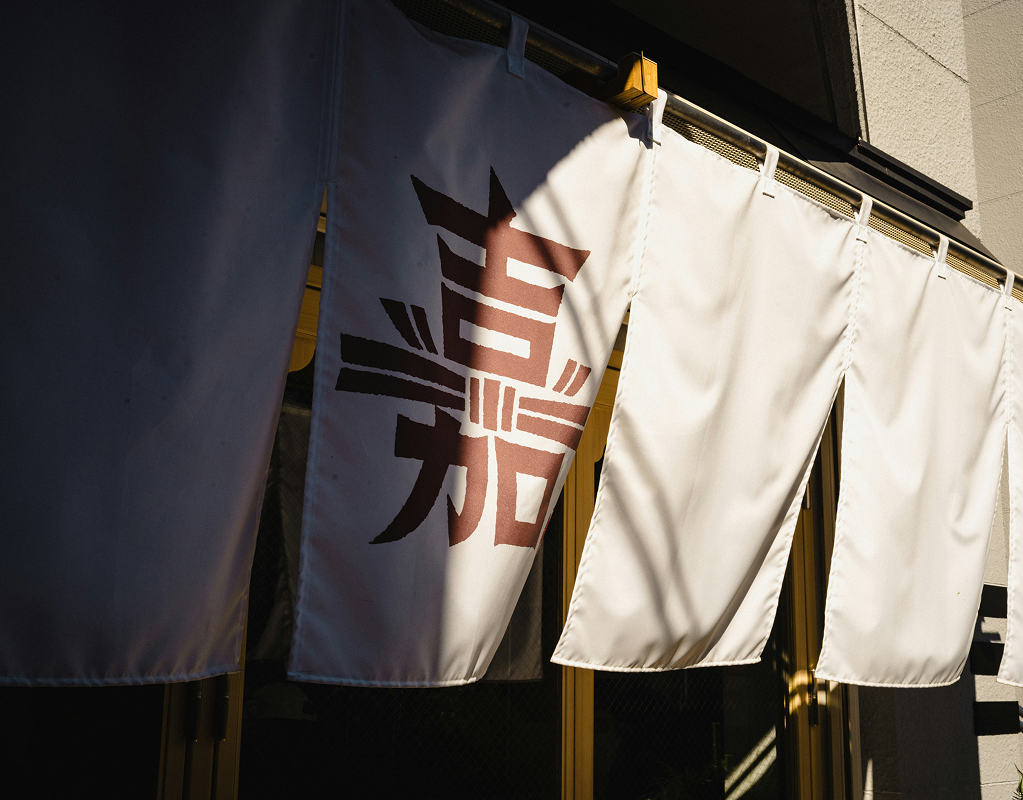
The Seto Inland Sea speaks to that shift beautifully. It’s less about collecting landmarks and more about settling into the atmosphere between moments: the hush of a ferry ride at dusk, the soft chime of a temple bell carrying across the water, the discovery of a tiny family-run soba shop with noren curtains swaying in the breeze outside.
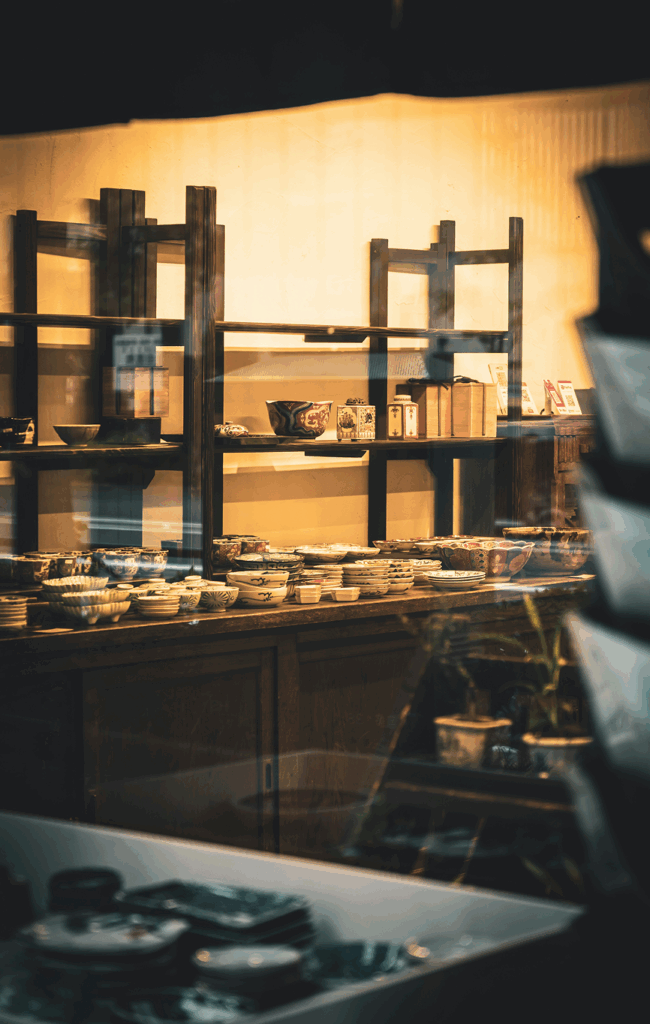
You might stumble into a ceramics studio tucked behind a quiet street in Teshima or find yourself lingering in a neighborhood sentō where locals move through familiar routines with practiced ease.
Nothing here fights for your attention, which somehow makes you pay closer attention to everything.
For years, many people approached Japan the same way they approached Europe for the first time — moving quickly, covering ground, optimizing itineraries down to the hour. Tokyo in three days. Kyoto in two. Somewhere along the way, travel began to feel strangely transactional, more focused on proof of experience than the experience itself.
But travelers are shifting toward something different now. Slower mornings. Boutique stays. Restaurants without lines wrapped around the block. Neighborhoods where life still exists beyond tourism. Space to wander without immediately feeling the pressure to turn every moment into content.
The Seto Inland Sea feels almost perfectly suited to that kind of travel.
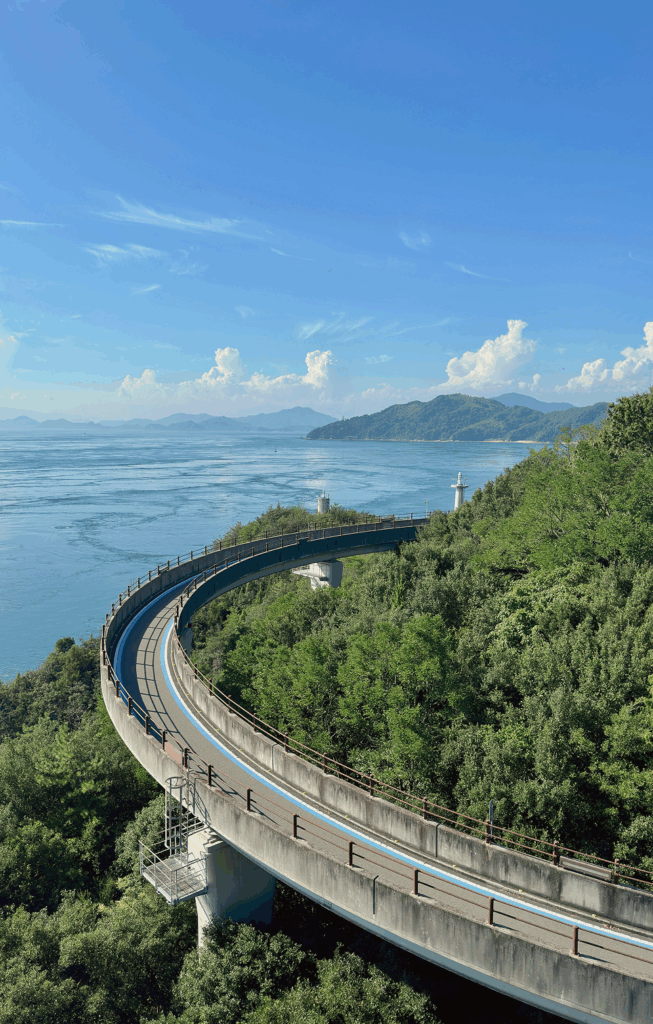
One day might unfold along the Shimanami Kaido, cycling across bridges suspended above the sea as fishing boats drift below and tiny islands rise in the distance like brushstrokes across the horizon.
Another might lead you through coastal towns where everyday life still revolves around the water, past working harbors, family-run shops and quiet streets where little seems rushed.
Elsewhere, there are hillside temples wrapped in cedar trees, floating oyster farms rocking gently offshore and old bathhouses where the wooden floors creak softly beneath your feet. Tiny cafés serve beautifully simple lunches that feel inseparable from the view outside the window. Even the convenience stores somehow feel cinematic here. Part of the beauty of the region is that nothing feels overly curated for outsiders. It still feels lived in.
And that restraint — that refusal to oversell itself — is exactly what makes the Seto Inland Sea feel so modern right now. Because luxury has changed too.
It’s no longer only about excess or exclusivity. Increasingly, luxury feels like space. Silence. A hotel room overlooking still water. Time to linger over dinner without rushing toward the next reservation. The rare experience of returning home from a trip feeling calmer rather than overstimulated.
The Seto Inland Sea rewards travelers willing to move at that pace.
And while the region has long been beloved within Japan, internationally it still carries the feeling of being slightly ahead of the curve — the kind of place people hear about through a friend whose taste they trust implicitly.
Not hidden exactly. Just not overrun.
There’s a particular satisfaction in finding places like this before they become everyone’s next obsession, not because exclusivity matters, but because some destinations are best experienced before the noise arrives.
The Seto Inland Sea still offers that increasingly rare sense of discovery. It asks you to slow down enough to notice things again: the changing light on the water, the rhythm of island life, the beauty of having nowhere urgent to be.
And once you experience Japan this way, it becomes surprisingly difficult to imagine traveling any other way.
Picture this: you’re taking in vineyard views, a glass of wine in hand, reflecting on the waterfront bike ride from a few days before and anticipating an evening that lets you linger in the beauty of it all. This is the European summer so many dream about.
The good news is, you don’t need a flight to Europe to find it. The San Francisco Bay Area offers its own take on the classic Euro summer, with breezy afternoons, lush forest scenery, and Napa Valley wines to close out the day.
Here’s what gives this non-European summer destination its European feel…
01
Small-town allure
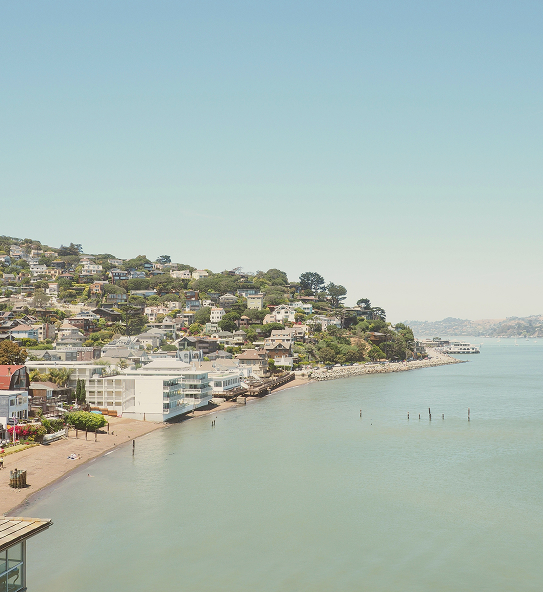
Just north of the Golden Gate Bridge, Sausalito is a waterfront town defined by a sense of ease that seems to take over when you stay. Wandering Sausalito’s maze of restaurants and locally owned shops feels a bit like stepping on a film set. Comparable to the quaint seaside villages in France and Italy, be sure you take your time, soak it all in, and pick up a souvenir (or two) before leaving this fairy tale destination.
02
Vineyards galore
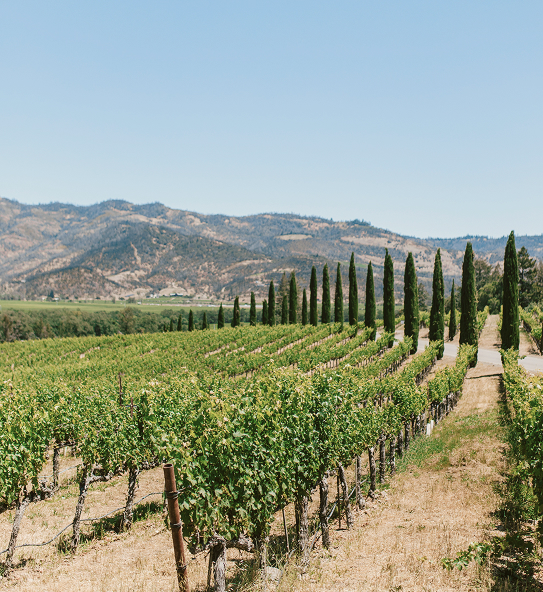
Often considered the Tuscany of North America, Napa Valley evokes the romance of the Italian countryside with its lush vineyards and slower pace. Its world-renowned wineries and signature Cabernet Sauvignon have made it a destination synonymous with wine culture, but the appeal goes beyond the glass. The mountain ranges, culinary delights, and bright skies make the entire visit feel complete.
03
Nature’s light show
No need to venture to Ireland when Tomales Bay transforms into a bioluminescent experience unlike any other after the sun sets. As plankton shimmer beneath the surface, the water comes alive with an otherworldly glow – even more magical when viewed from a kayak, as each stroke of your paddle illuminates the water around you.
04
Across the Golden Gate
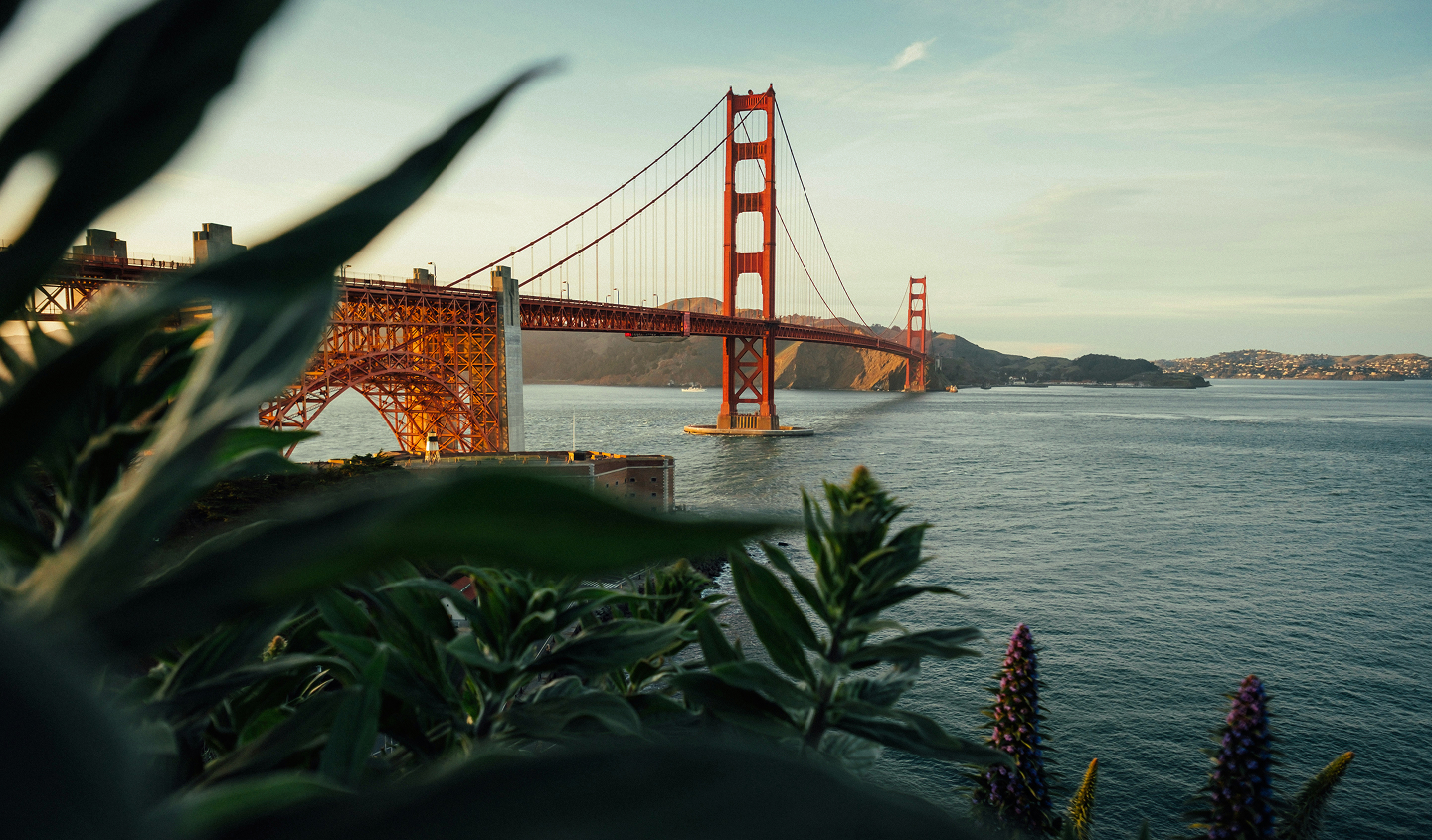
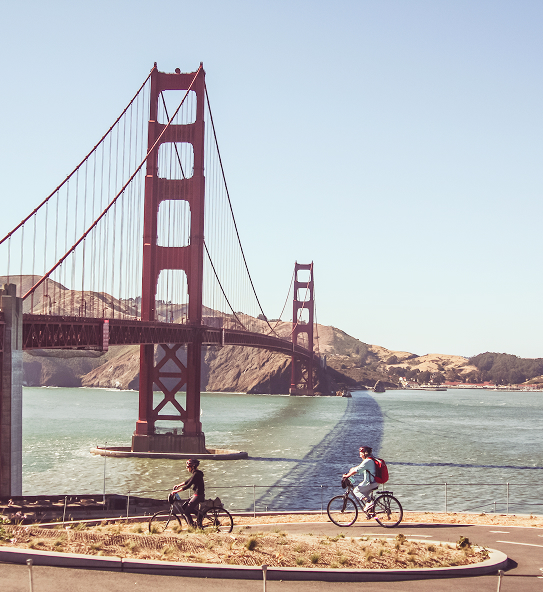
Biking across San Francisco’s Golden Gate Bridge is one of those experiences you don’t realize you need until you’re in the moment. With the breeze rushing by, water on either side, and views from all angles, riding across this landmark is both thrilling and memorable.
05
Into the woods
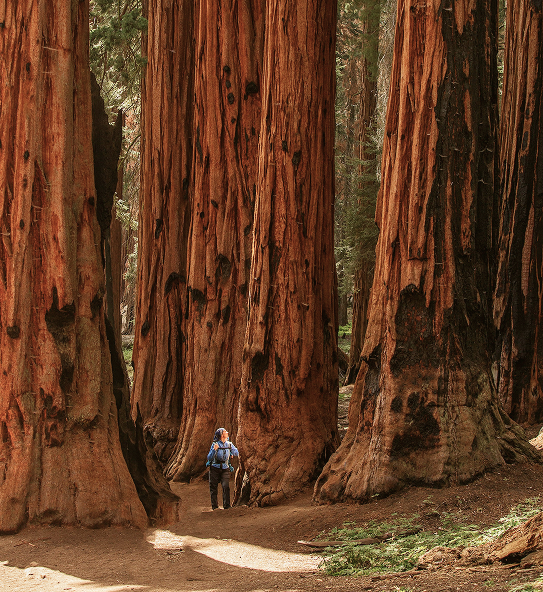
Your forest fairy tale can still come to life in California’s Armstrong Redwoods State Natural Reserve, where towering trees rise like ancient guardians and the entire landscape is full of wonder. Rooted here for centuries, many of these giants have stood longer than your great-great-grandparents!
06
Charming accommodations
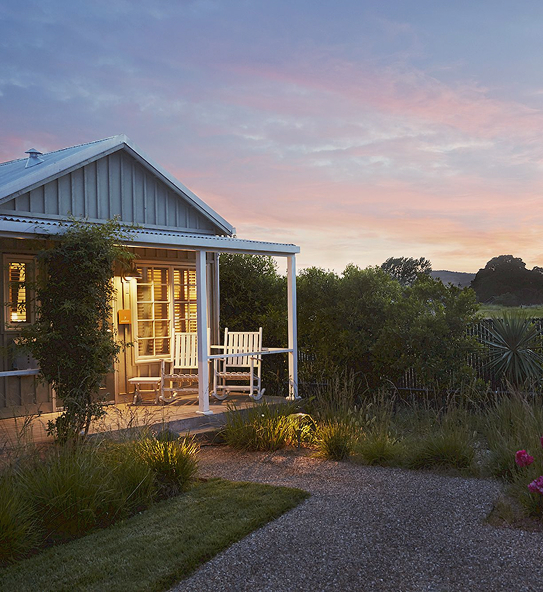
Surrounded by Napa Valley vineyards, fresh air, and a peaceful atmosphere, Carneros Resort and Spa offers a stay that feels both luxurious and grounded in its setting. This resort checks every box for the perfect stay – think your own private standalone cottage, fireplaces that add to the coziness, and open-air soaking tubs made for unwinding. It’s the kind of place where you can slow down, reconnect with nature, and savor good company.
With such a big world and so many bucket-list destinations to check off, it can be easy to overlook what’s closer to home. But sometimes the most special getaways are the ones that invite you to slow down, see a familiar place in a new light, and discover that touch of Europe – it’s right in your own backyard!
Whether you’re a seasoned European traveler or have never been to the continent, you’ll find something familiar in the breezy beauty and relaxed charm of this region. The Golden Gate & Wine Country offers a distinct aesthetic all its own, with no passport required.
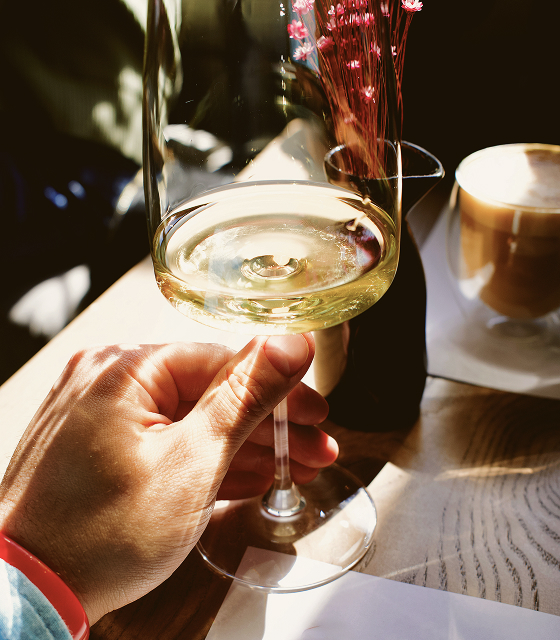
The first glass of wine I ever had was in an airport.
I was sitting in a wine bar in Washington Dulles International Airport, waiting for a flight home after a client meeting with a popular dial-up internet provider. (Yes kids, we used to have to call the Internet.)
Across the table was my boss – the guy who taught me pretty much everything I know about being a professional copywriter.
He ordered a Sauvignon Blanc.
At that point in my life, I knew absolutely nothing about wine. (Shoutout to Gabby, who recently admitted the same in her Unscripted blog post. It’s good. You should read it.)
So I did what any young professional trying to look like they belonged in a wine bar would do. I said, “I’ll have the same.”
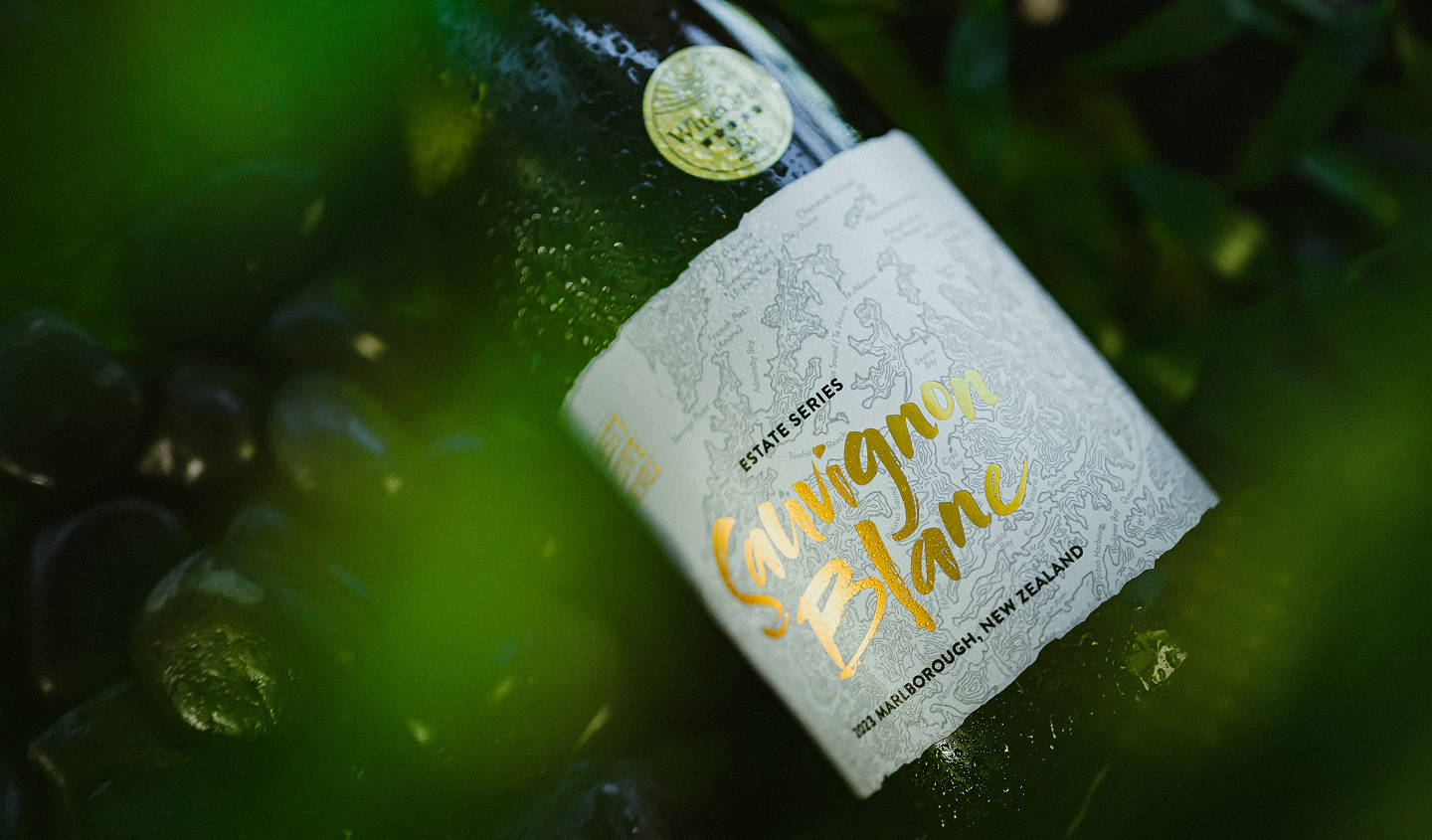
The bottle was The Crossings, from the Marlborough region of New Zealand.
And I remember thinking something very simple:
Ooh… I like this.
Bright. Fresh. A little citrusy. Super easy to drink. It felt summery, even though we were in an airport. In Dulles.
I didn’t know it at the time, but that first glass happened to come from one of the places in the world where Sauvignon Blanc thrives.
So why is Marlborough so good at this?
The short version is: the environment there is almost unfairly perfect for the grape.
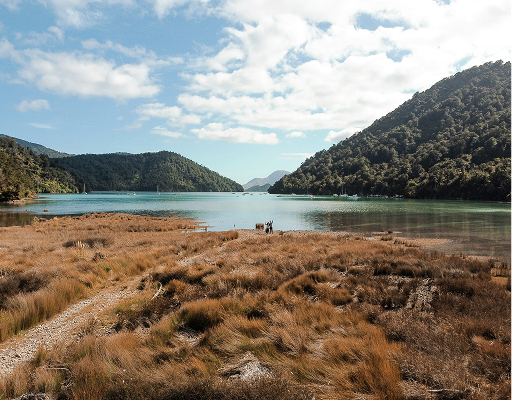
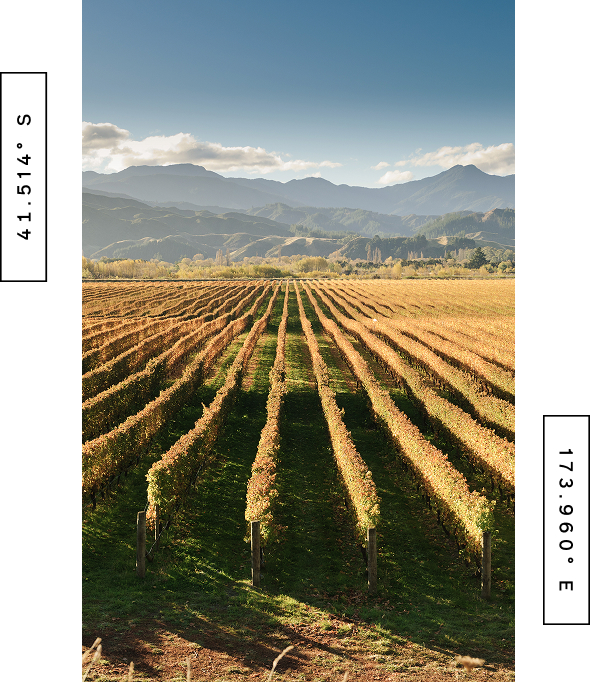
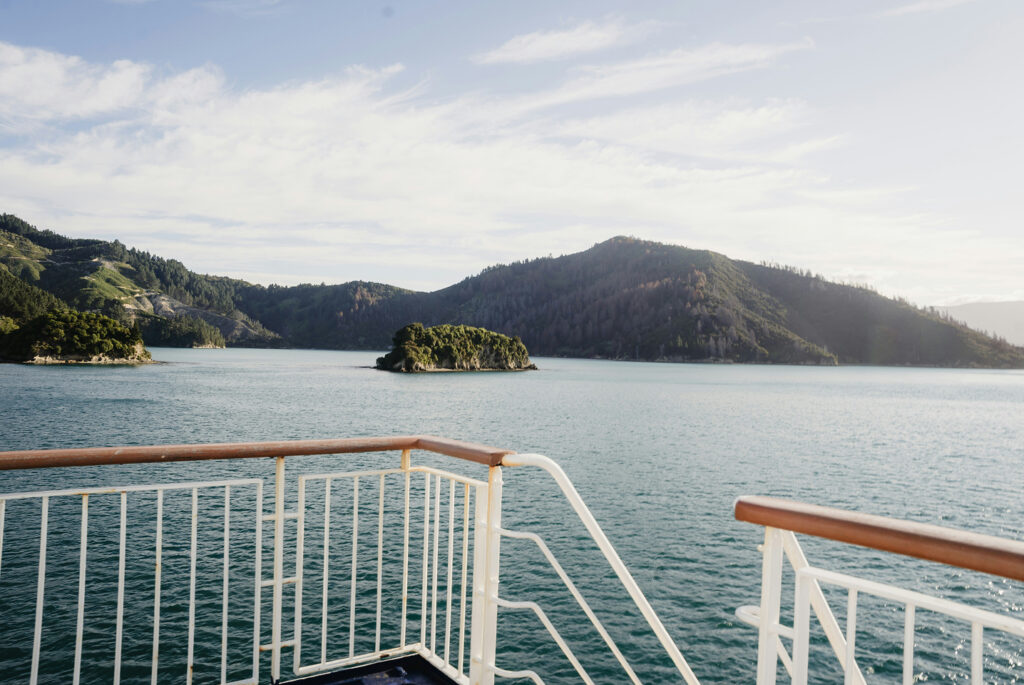
Marlborough sits at the top of New Zealand’s South Island, where vineyards get long sunny days and very cool nights. That temperature swing helps Sauvignon Blanc keep its crisp acidity – the thing that makes it feel so refreshing.
The soils there are rocky and well-drained, which forces the vines to work a little harder. Hard-working vines tend to produce smaller grapes with more concentrated flavor.
Then there’s the ocean. Marlborough isn’t far from the sea, so the air stays cool and clean, and breezes move through the vineyards. The result is Sauvignon Blanc that’s intensely aromatic – lime, grapefruit, passionfruit – but still sharp and lively. (At least that’s what I’ve read… I honestly couldn’t tell you what a passionfruit tastes like.)
It’s the wine equivalent of turning the brightness all the way up.
A WINE THAT MATCHES THE LANDSCAPE
There’s another reason Marlborough Sauvignon Blanc works so well. It tastes like the place it comes from.
New Zealand is a country of big skies, sea air, and landscapes that feel incredibly alive – the kind of place where you’re hiking coastal trails one day and staring at waterfalls the next.
That freshness shows up in the wine.
On our New Zealand: North & South journey, one stop takes you straight into the Marlborough wine region, where you sit down for lunch at a boutique vineyard and taste local wines just steps from where they’re grown.
It’s one of those moments where the wine suddenly makes complete sense. The air, the light, the ocean nearby – it all feels connected.
The first glass still wins
I’ve had plenty of wine since that glass in the airport. Some expensive. Some in a box. But that first Marlborough Sauvignon Blanc still sticks with me.
Maybe because it was my first.
Or maybe because, completely by accident, I picked one of the best places in the world to start. (Marlborough, not Dulles.)
Wine is everywhere – always has been, always will be.
As early as 8,000 years ago, when Georgians realized fermented grape juice could become something special, wine began weaving itself into human life. Ancient Egyptians used it in ceremonies. Greeks linked it to celebration and rebirth. The Romans carried winemaking across Europe. And us? We like to make napkins that say, “If you combine wine and dinner, you get winner,” and pass them around Thursday night book club.
It shows up at dinner parties, gets wrapped in silver foil for the holidays, and is quietly assumed to be something everyone enjoys. And if it’s not your thing? You learn to nod along and pretend it is.
I’ll go first: I’m not a wine drinker, and I proudly know the bare minimum.
If you’re looking for a beginner’s guide to wine, you won’t find it here. But maybe you’ll find permission to enjoy wine without needing to understand it fully, and to let it exist in its simplest form.
I went to college in New York City, and when my friends and I wanted to feel a little more “grown-up,” we found ourselves on the barstools of a wine bar on West 51st Street – sipping glasses of wine we couldn’t pronounce and convincing ourselves we liked. We all carried this unspoken idea that adults drink wine, and if we wanted to play the part, we had to trade our vodka sodas for a glass of Chardonnay.
Under the table, I was Googling the difference between dry and sweet, bold versus mild, mineralized reds, and why so many wines start with “pinot.” Anything that made us sound like we knew what we were talking about – definitely not 19 – and that we belonged.
In that moment, I was grouping knowing with belonging – and that was the mistake. You don’t need to know wine to appreciate it.
These days, wine culture can feel intimidating when you don’t label yourself a wine drinker – and it’s not something you can really ignore. Whether you’re traveling through Northern California, Italy, Spain, South Africa, France, or Australia, wine always seems to follow. No matter what’s in your glass, there’s no special invitation you need to accept – as long as you’re willing to notice.
A novice wine drinker goes undercover at a wine tasting
I’ve come to understand wine a little more since those performative wine-drinking days. I still don’t know why so many wines start with pinot (a quick search tells me it’s a French way to describe the pine-cone-like clusters of grapes), but I’ve gone wine tasting in a handful of countries since then.
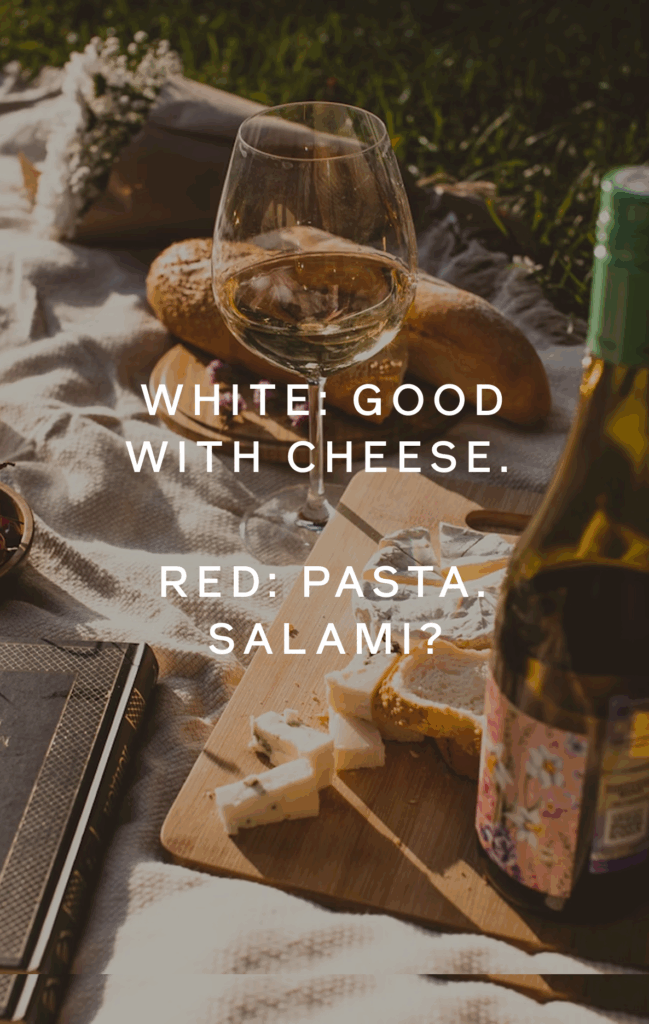
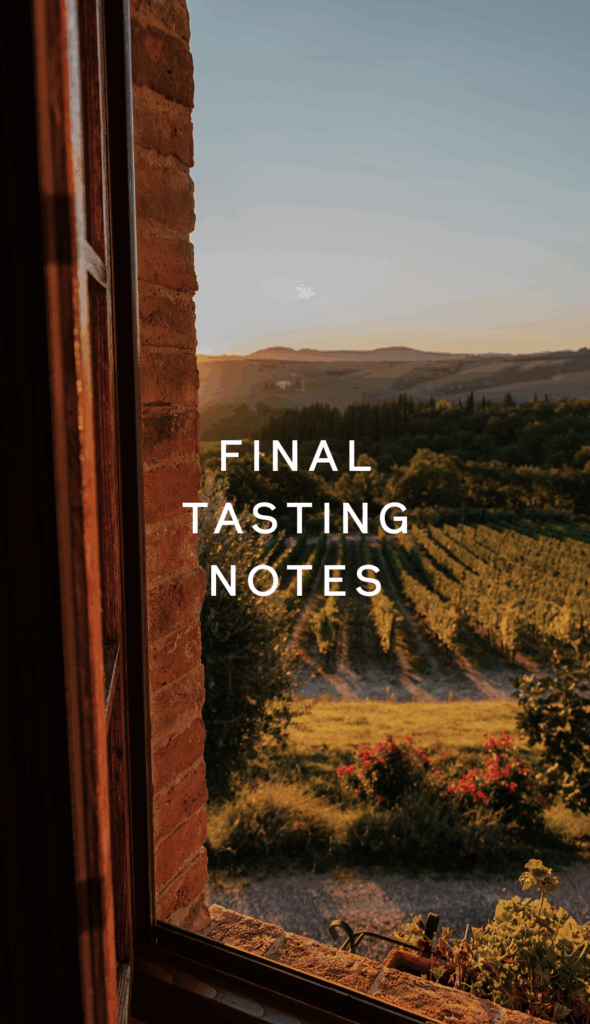
My tasting notes from Tuscany speak for themselves:
White: good with cheese. Red: pasta. Salami?
For a writer, it’s hardly poetic. Hardly helpful. And yet for someone who doesn’t really know wine, those scribbles are still tied to some of my best memories of that trip.
When you go to a wine tasting, you start to realize wine is patient. It begins with vines that need years before they’re ready. Then comes harvest – early mornings, stained hands, and planning that depends on weather, instinct, and timing. Grapes are crushed, juice ferments, and the story continues.
No one cares if you don’t know wine. They just want to share what they’ve made. And even if you don’t love what you’re tasting, you’re still connecting more deeply to the earth you’re exploring – discovering how unique and different we all are through each sip. At vineyards and wineries, it’s like a living art gallery. They want to tell you about the year the rain came too late, or the harvest that nearly didn’t happen, or the family tradition that’s been passed down longer than anyone can remember.
There’s a world of wine knowledge out there – and it’s fascinating. If you want a low-pressure way to taste without pretending, here’s what I’ve learned:
Dry usually means “not sweet.” Crisp means it has acidity (think refreshing, not sour). And if a wine feels “heavy,” that’s body.
That’s it. That’s all you need to know to enjoy the start of its story.
And still, we raise our glass
In many places, wine wasn’t made to be studied. It was made to bring people together. Over centuries, families passed down traditions, and regions shaped identity around what could grow from their soil. That’s why it often feels less about what’s in the glass and more about what’s happening around it.
A little bit of travel only reinforced that.
In Italy, wine lingers at the table just long enough to invite another story. In France, it’s part of daily life – casual, confident. In Spain, it’s social glue – passed around late into the night with tapas and laughter. In Austria, it’s tied to the land itself.
No region does it the same, yet they all make room for it at the table. Civilizations evolved alongside wine. It belongs to all of us, whether we feel like “wine people” or not. Through traveling places where I only know how to say “hello” and “thank you,” I’ve come to see wine as its own language – an appreciation for life and an invitation to connect.
Here’s what I know now:
1. You don’t have to be a wine person to enjoy wine.
2. You don’t need the vocabulary.
3. You don’t have to love every glass.
4. And you certainly don’t have to pretend.
Appreciation doesn’t come from knowledge – it comes from attention. From noticing where you are. Who you’re with. How the moment feels.
At its best, wine is just a way in – a doorway into the world and the cultures that shape it. You don’t need to play the part – just be open to the story.
Walk the cobbled streets of a Portuguese town at dusk and you may hear it: a guitar’s bright ripple from behind a doorway, followed by a voice that seems to rise from somewhere deeper than the lungs. The air stills. Someone sings not just to fill the room but to press memory into the present moment.
This is Fado. Portugal’s music of longing. Not background noise, not entertainment engineered for applause. It is intimacy given form – music that reminds you how it feels to miss something you can’t name.
A Tradition Rooted in Saudade
At the center of Fado is a single word: saudade. The Portuguese will tell you it has no translation. It is longing and absence, nostalgia and ache – the kind of feeling that lives in both joy and sorrow.
Fado was born in the 19th century in taverns and alleys, sung by sailors leaving for voyages they might not survive, by women whose lives were marked by both love and loss. These weren’t polished performances. They were confessions set to melody.
Even now, when you hear Fado sung in an intimate tavern or café, you hear that same thread – voices carrying stories heavy enough to bend the air, yet lifted into beauty. It isn’t about perfection. It’s about presence.
The Sound That Cuts Through Silence
The song begins not with words but with the guitarra portuguesa, a teardrop-shaped 12-string whose sound is sharp and metallic, like light bouncing off water. Then comes the viola, the steady classical guitar that grounds everything. One voice sings, and suddenly the room holds its breath.
The effect is unlike anything polished in a studio. It is a conversation between instruments, between singer and silence, between performer and listener. Each note lingers just long enough to let you feel it – not rushed, not overdone.
It’s the kind of music that reminds you of old records your parents played when you were young. Songs that carried more than melody. Songs that left space for you to sit, sway, and feel.
Where Fado Lives Today
Though Fado has deep roots in Lisbon and Coimbra, the tradition is not bound to one place. Across Portugal — from Porto’s taverns to the wine towns along the Douro Valley — you can still step into a quiet room and feel the music take hold.
In 2011, UNESCO recognized Fado as part of the Intangible Cultural Heritage of Humanity. Yet it has always been more than a cultural artifact. It’s a living expression, sung nightly in neighborhoods where the music remains part of daily life.
Why It Resonates With Travelers Today
We travel now not to tick boxes but to find moments that stay with us. Fado is one of those moments.
You don’t need to speak Portuguese. The music bypasses language and goes straight to feeling. A single lyric may rise like a tide, and before you understand it, you’re already moved.
For travelers who’ve lived enough to carry both triumphs and scars — the draw is unmistakable. Fado isn’t entertainment for an evening. It’s a mirror. It pulls you into your own memories: of something lost, of something loved and longed for, of something you still hope to find.
Music of Memory, Music of Now
Fado is rooted in history, but it does not sit still. Today’s singers bend the tradition in new directions — Mariza carrying it onto the world stage, young artists blending old melodies with modern rhythms. Each performance holds the past in one hand and the future in the other.
Like travel itself, Fado is never finished. Each night, each voice, each listener makes it new.
Lingering Notes
The best travel moments don’t always come with sweeping views or grand monuments. Sometimes they arrive as a quiet song in a small room, a voice reminding you that to be human is to long, to remember, to feel.
Fado lingers long after the last note fades. You walk back into the night, the echo still inside you — as if the music has rewound something in your own story.
It is more than a performance. It is a pause. A reminder to slow down, listen, and take in what is here, now.
Because in the end, Fado isn’t just Portugal’s music. It is a universal invitation: to surrender to the moment, to let memory and melody meet, and to carry that resonance long after the journey ends .
I never expected to find myself back in Budapest so soon – less than two years after my first visit – but the city has a way of pulling you back. Budapest is one of those cities that feels like home, but just a little more exciting.
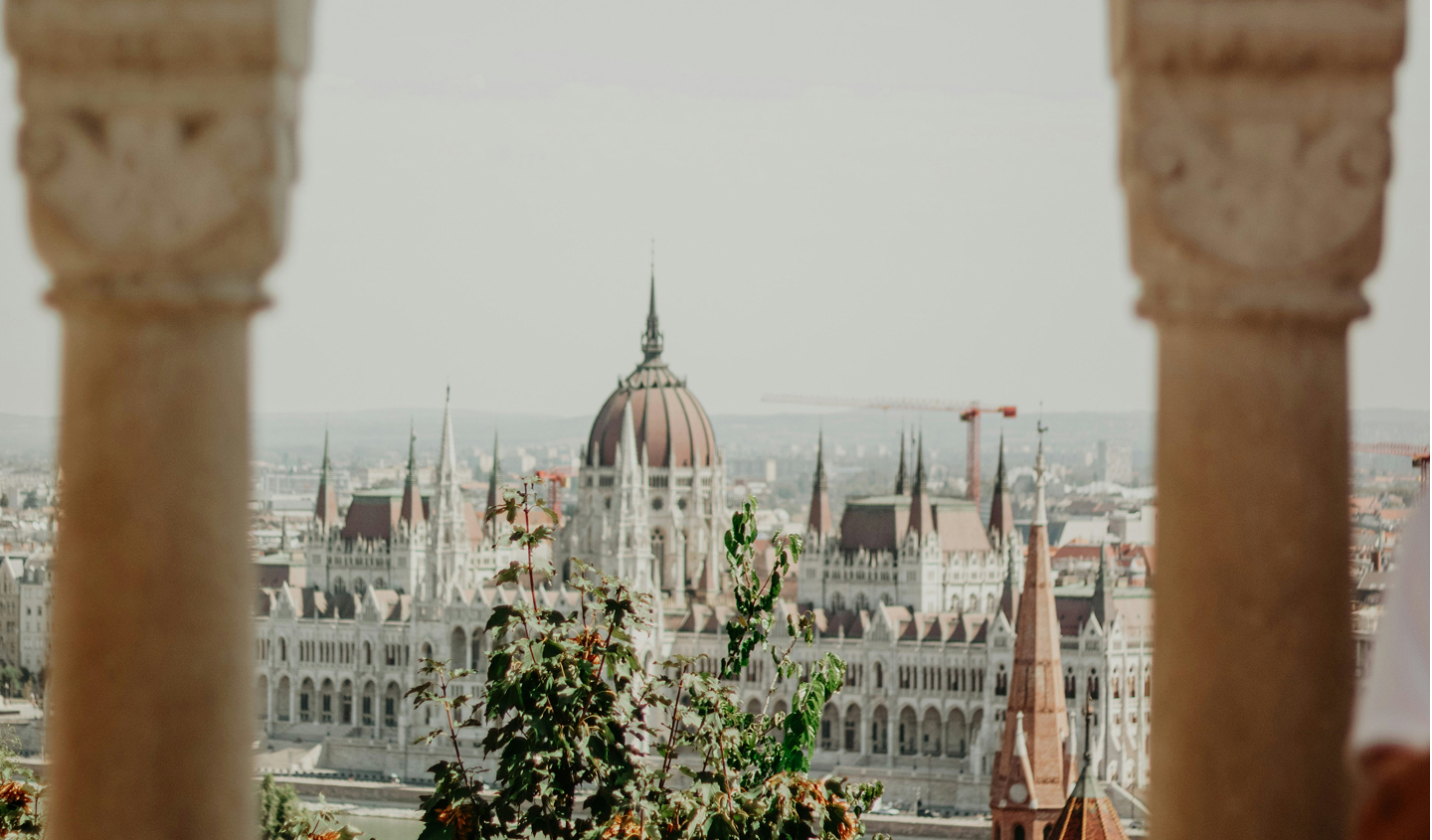
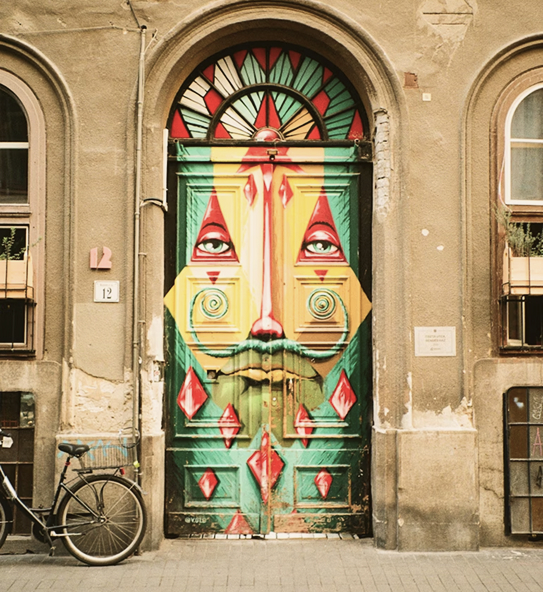
First-time visitors can’t miss Budapest’s greatest hits – the Hungarian Parliament, Chains Bridge, Fisherman’s Bastion, Matthias Church, and St. Stephen’s Cathedral. They’re every bit as spectacular as the Internet promises. But the real magic of the city is tucked away in the side streets, the cozy restaurants, and the quaint shops. As Budapest’s number one fan, I can assure you there’s no such thing as a dull moment here.
01
for the photo ops
While every corner of this city is photogenic, these particular spots are begging for your cameras to come out.
Heroes’ Square
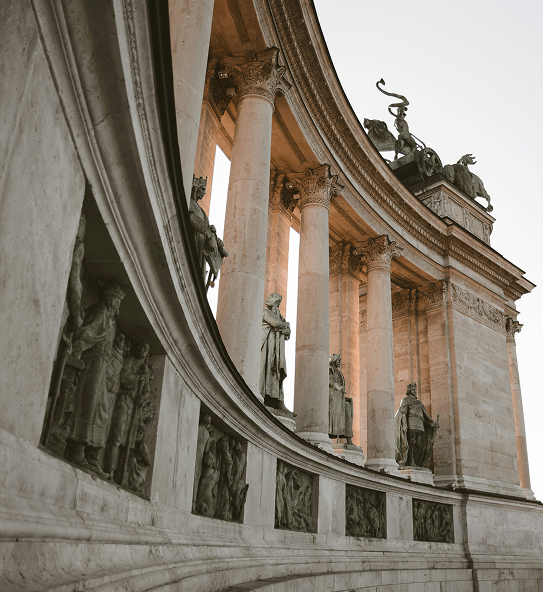
Heroes’ Square is one of the major squares in the city, notably for its iconic Millennium Monument, but there’s an enchanting presence that makes you feel like you’ve stepped into the wizarding world of Harry Potter, with its magical atmosphere and grand buildings. I spent over an hour capturing photos from every angle!
Gellért Hill
At 235 meters, the climb up Gellért Hill isn’t a leisurely stroll (it’s a workout). But the moment when you reach the top speaks for itself – take in the stunning views of the Danube and the rest of the city (you’ve earned it)!
02
for the foodies
If you’re anything like me, then you know half the joy of traveling is in the eating. Budapest makes it dangerously easy to spend your time restaurant and bar hopping… with a mix of Hungarian and Turkish cuisine, there are a lot of classics to try before you leave.
Retek Bisztró
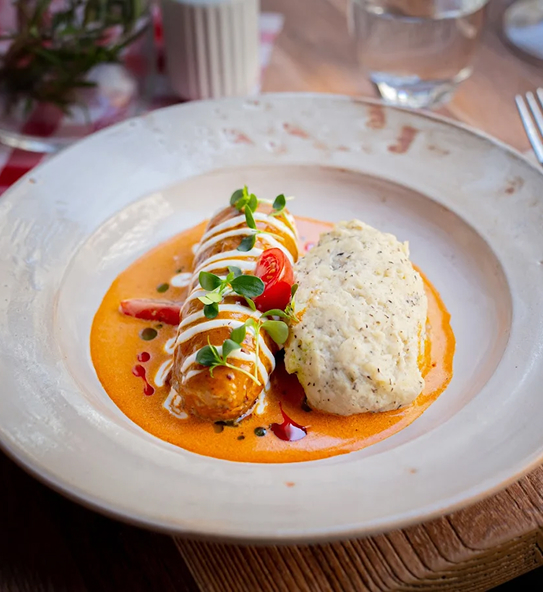
This cozy spot feels like you’re eating in grandma’s kitchen – warm and comforting. The hearty goulash soup here is the kind that sticks with you. The flavorful chicken paprikash will have you inspired to start cooking.
Twentysix Budapest
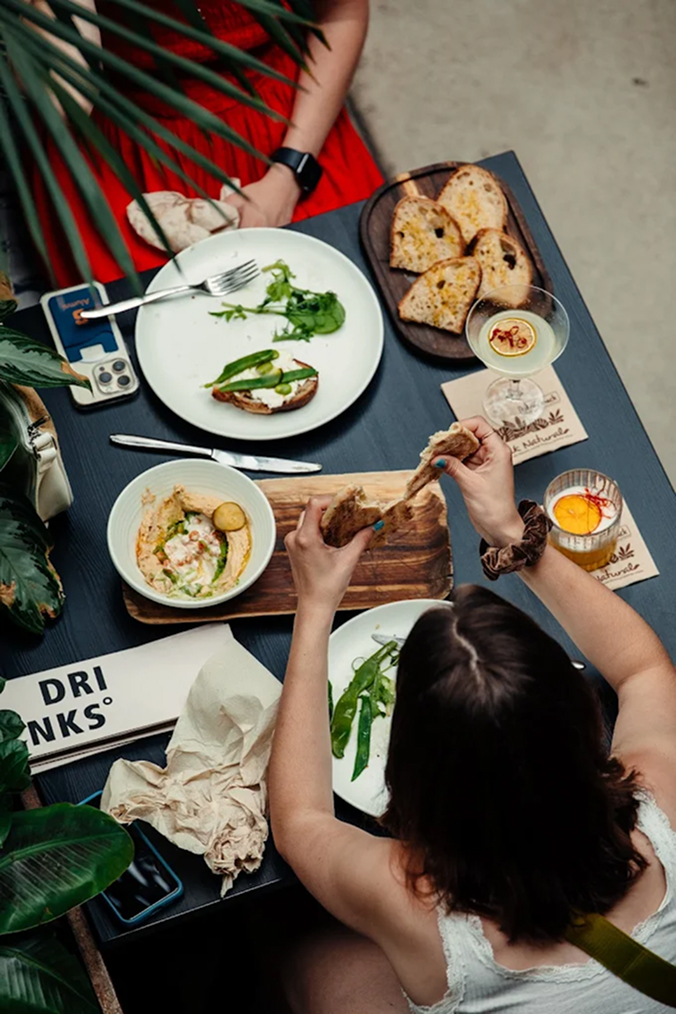
A tropical, jungle oasis is how many visitors and locals describe this Mediterranean gem. Step into a greenhouse garden and indulge in fresh shrimp and tzatziki. The city’s Mediterranean flavors echo Budapest’s Ottoman history in the most delicious way.
Chimney Cake
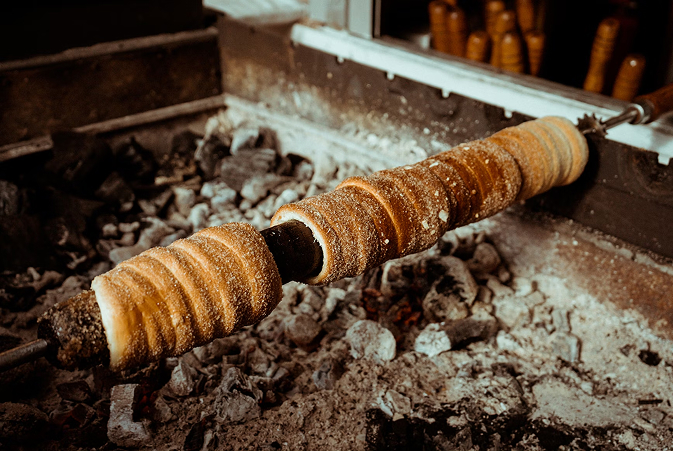
You’ll see these everywhere – sweet, spiraled pastries dusted with sugar and sometimes filled with chocolate or nuts. They’re more than just a delicious street snack; they’re one of Hungary’s oldest treats. So, grab one hot off the grill and embrace the sugar rush.
Ruin bars
Ruin bars are among Budapest’s most distinctive attractions. These venues – mainly located in the Jewish Quarter – were repurposed in the early 2000s and now boast eclectic atmospheres and quirky wall art, with plenty of hidden corners to discover.At 235 meters, the climb up Gellért Hill isn’t a leisurely stroll (it’s a workout). But the moment when you reach the top speaks for itself – take in the stunning views of the Danube and the rest of the city (you’ve earned it)!
03
relax and rejevunate
Beneath all its lively streets and grand architecture lies a not-so-hidden secret… Budapest sits on a massive underground reserve of mineral-rich spring water, which means thermal baths are a way of life here.
Széchenyi Thermal Bath
If you’re going to dip your toes (literally) into this part of Budapest culture, Széchenyi is the place to start. It’s one of the largest spa baths in Europe. Yes, the crowds can be intense, but the moment you sink into the steaming waters, it all fades away. The stunning, neo-Baroque building makes for a great background as you enjoy the warmth of the spa.
Rudas Thermal Bath
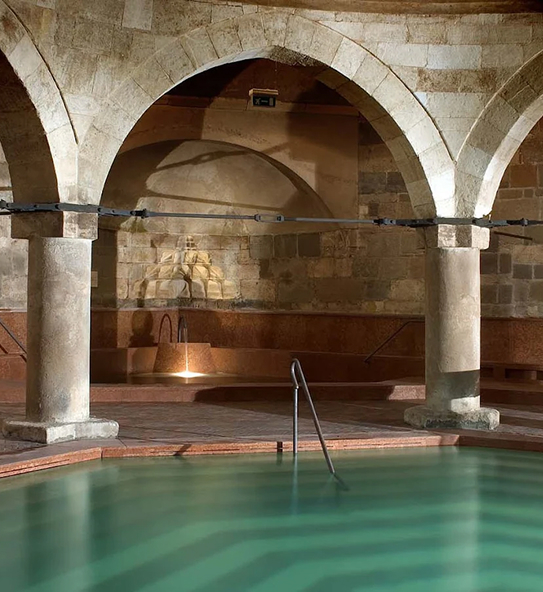
Just a short distance away from Elizabeth Bridge, Rudas Thermal Bath blends historic charm with modern comfort, offering everything from its iconic octagonal Turkish thermal bath to a rooftop panoramic pool that pairs authentic tradition with a contemporary twist.
04
retail therapy
Every trip needs a little shopping break, right? In Budapest, you’ll find plenty of places to tempt you!
Deák Ferenc ter (Fashion Street) & Váci Street
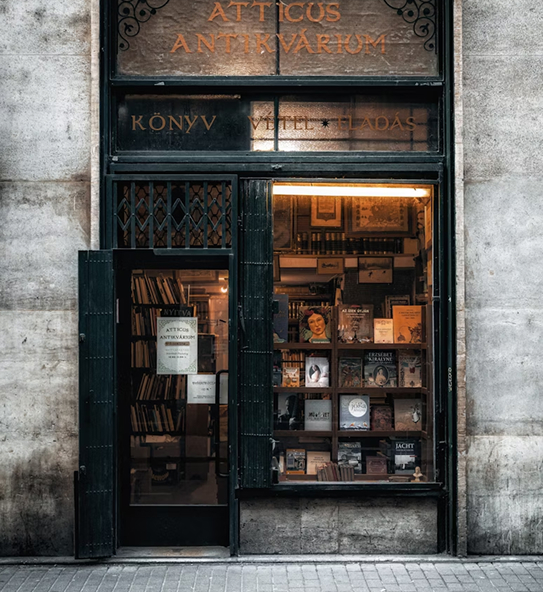
These are the go-to spots for retail wandering. Fashion Street is lined with upscale and international brands, while Váci Street has a mix of clothing stores, souvenir shops, and great dining options. If you’re on the hunt for something more unique or quirky, the Jewish Quarter has a wide variety of vintage shops where you can find one-of-a-kind items.
05
other “hidden” gems
While these sites aren’t exactly hidden, they are less commonly visited by tourists, but they’re worth slipping into your itinerary.
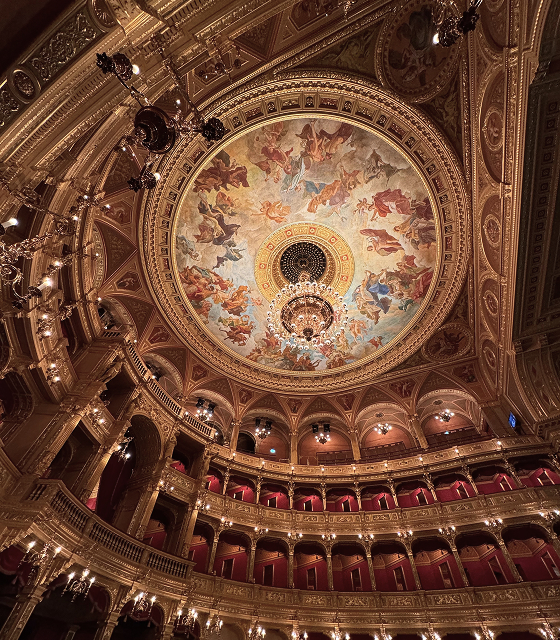
The Hungarian Opera House is a jaw-dropping building, whether you’re down to enjoy a performance or just popping in to admire the beautiful walls and theater, this is a site to amaze anyone.
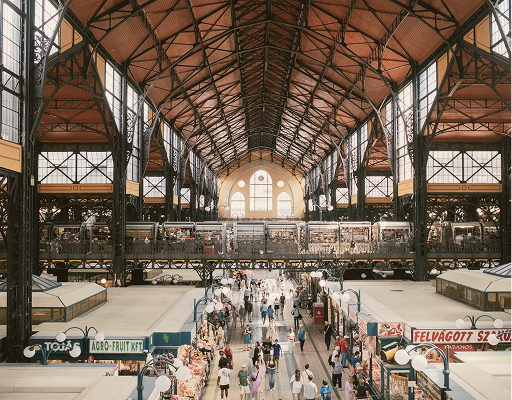
Another favorite is the Central Market Hall – a food and shopping hub, featuring multiple vendors. The outside of the building alone is worth a photo stop, but inside you’ll find everything from paprika to handcrafted goods.
And for the grand finale…
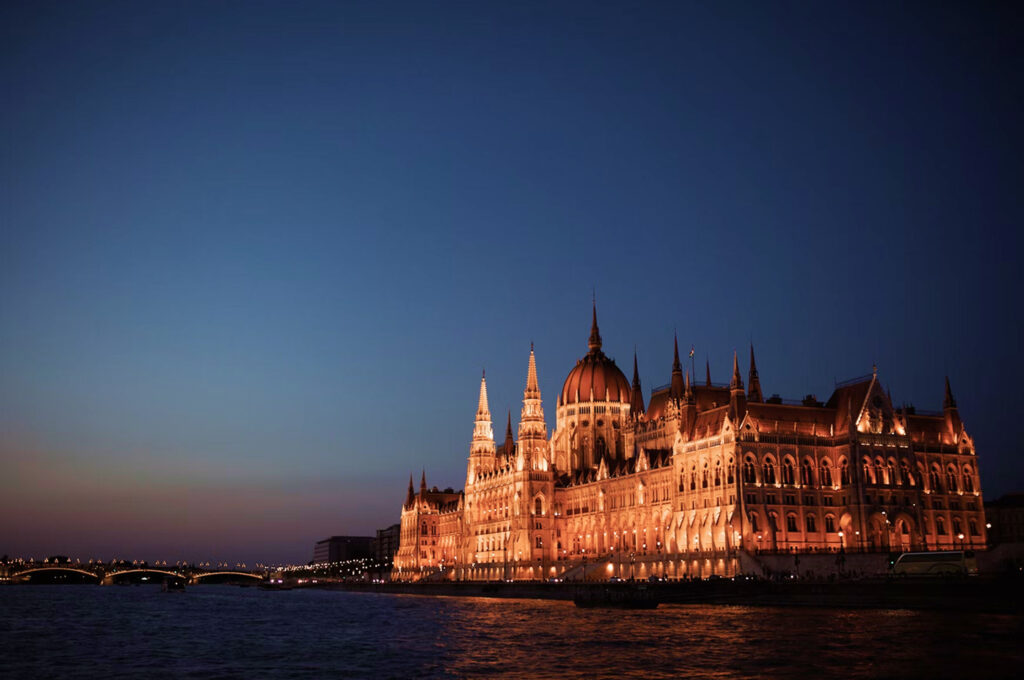
A trip to Budapest would not be complete without sailing down the Danube at night, champagne in hand, watching the city glow around you. The Hungarian Parliament steals the show – lit up and larger-than-life – it feels even more majestic up close.
All in all, make the time you have in Budapest yours – spend your free moments doing what excites you most, because not everything is for everyone. Whether you’re a culture connoisseur, an adventurous foodie, or fascinated by the thermal baths, the city offers countless ways to enjoy a free afternoon in Budapest. So, let yourself wander aimlessly, meet some locals, and dig a little deeper – savoring and exploring the Hungarian way.
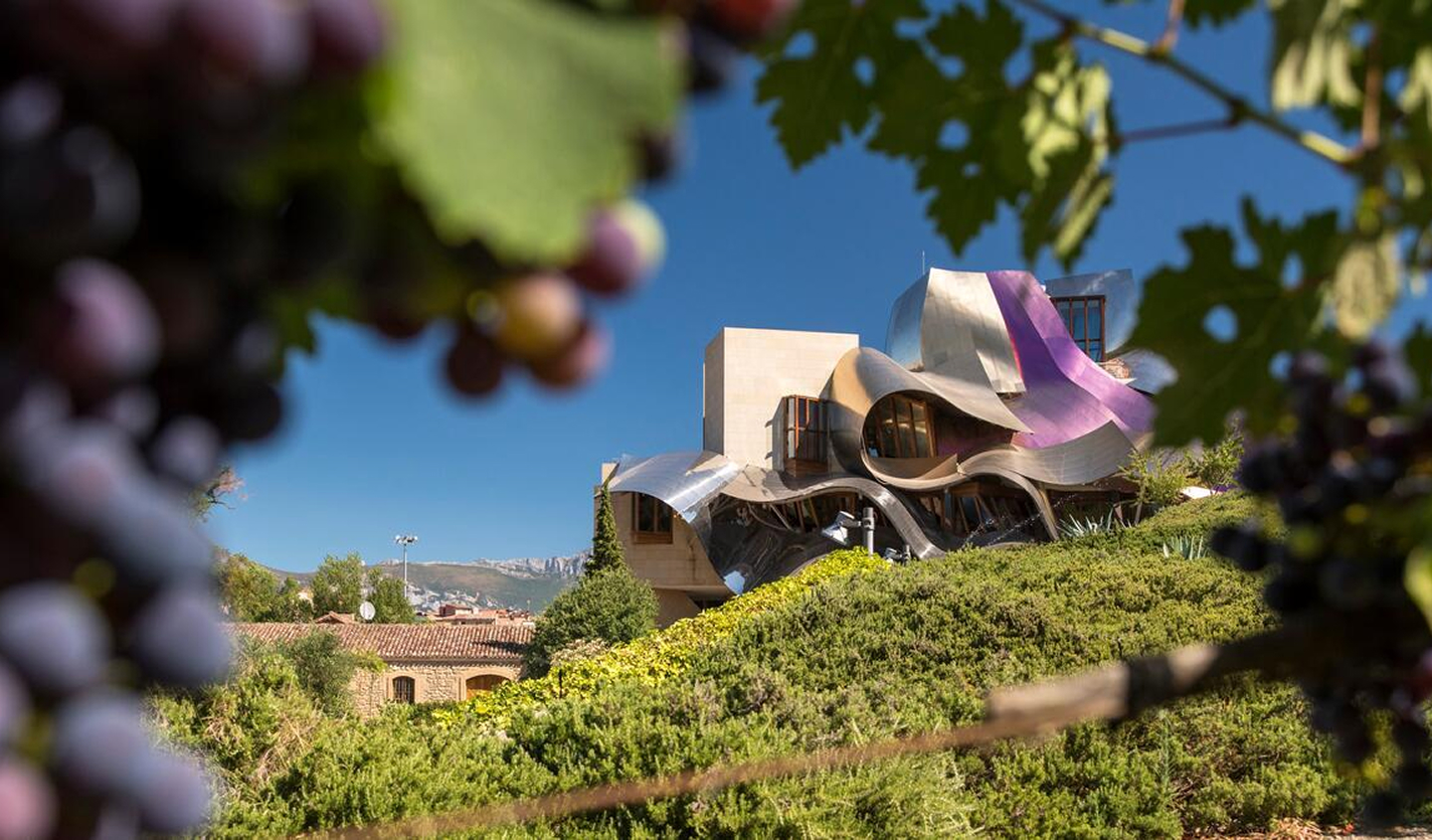
When you think of a medieval town in Northern Spain’s Basque Country with fewer than a thousand inhabitants, you probably think of winding, narrow streets, stone walls, bell towers, and churches. But Elciego, a small town dating back to the Roman Era, challenges that narrative. The hard-to-miss avant-garde Hotel Marqués de Riscal rises from this town and becomes a luxurious sanctuary for the senses.
Redefining modern architecture
Lead with a question, not a statement, is a philosophy that world-renowned architect Frank Gehry embraced throughout his career. Known as one of the most influential architects of the late 20th century and recipient of the prestigious Pritzker Architecture Prize, Gehry has always chased two simple words: Why not?
That pursuit has given the world icons such as the Guggenheim Bilbao, the Louis Vuitton Foundation in Paris, and Walt Disney Concert Hall in Los Angeles. To Gehry, architecture is art meant to spark curiosity, inspire interpretation, and hold your gaze. The five-star Marqués de Riscal, a Luxury Collection Hotel, is no exception.
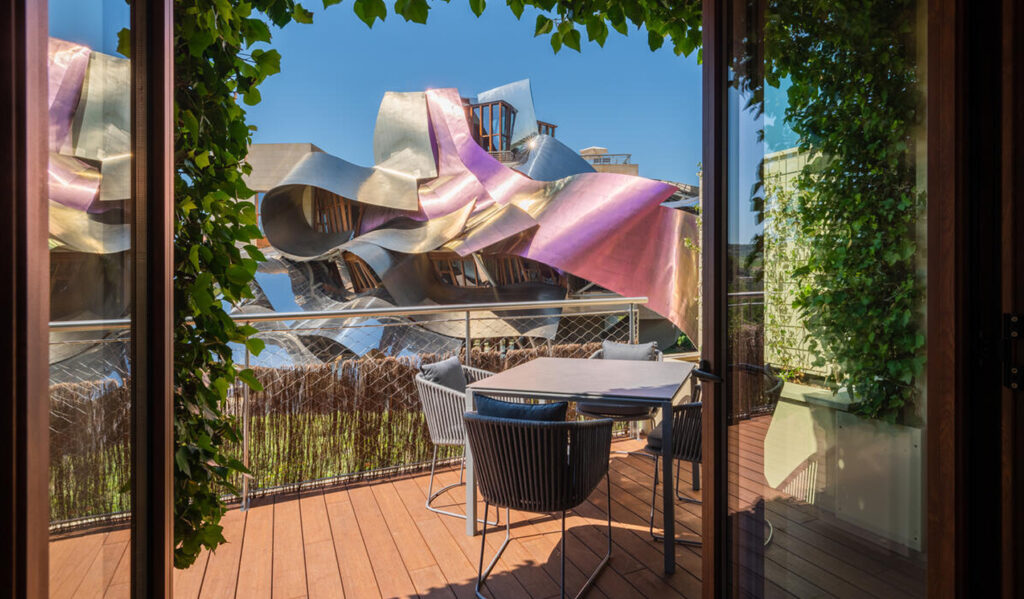
Its shimmering ribbons of titanium and steel rise unexpectedly above a horizon of Rioja Valley vineyards. Its façade curves and bends in ways that seem impossible – fluid and undeniably genius. It’s the kind of building you stare at, then tilt your head, then stare again – like a wine label you’re not sure how to pronounce but know will be good.
With every peak and ripple, it captures the metamorphosis of wine – its wave-like surfaces evoke tangled vines, the roundness of oak barrels, and the graceful pour into a glass.
The building’s colors do more than stand out against the orange and clay tones of the village below. Each shade has meaning: pink for the wine, gold for the mesh once used to protect bottles, and silver for the foil on the cap. From every angle, the building shows transformation, turning liquid into architecture and tradition into innovation.
CENTURIES OF WINE EXCELLENCE
But don’t let the contemporary exterior fool you. This is not just design for design’s sake – it is architecture rooted in centuries of wine culture.
Behind the futuristic façade lies a vineyard with one of the longest and most celebrated histories in Rioja. Founded in 1858, Marqués de Riscal was the first to bottle wine in the region. Within five years, it won its first awards, and by 1895, it became the first non-French wine to receive the Diploma of Honor at the Bordeaux Exhibition.
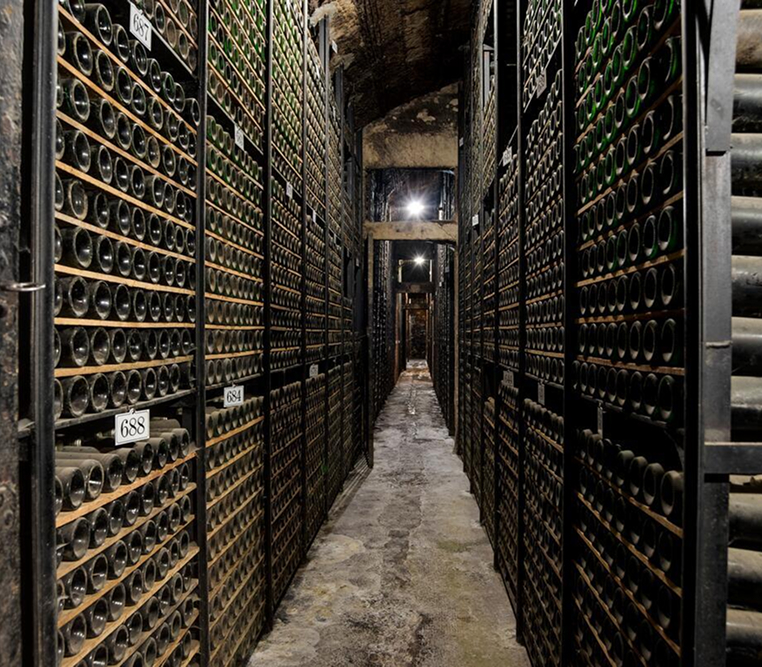
That pioneering spirit has never faded. In 2024, Marqués de Riscal was named Best Vineyard in the World in the World’s Best Vineyards awards. Its underground cellars – some lined with wines more than a century old – bottle this legacy, while the hotel above celebrates its evolution. And naturally, when you’re here, you don’t just feel invited into art but rather connected to a lineage of centuries of success and transformation.
A retreat for more than just your palate
We’ve established that wine at Marqués de Riscal is more than a drink; it is a philosophy of life, transformation, and renewal. That same spirit flows into the Spa Vinothérapie® Caudalie, where the healing power of the grape becomes a ritual for the body as much as for the palate.
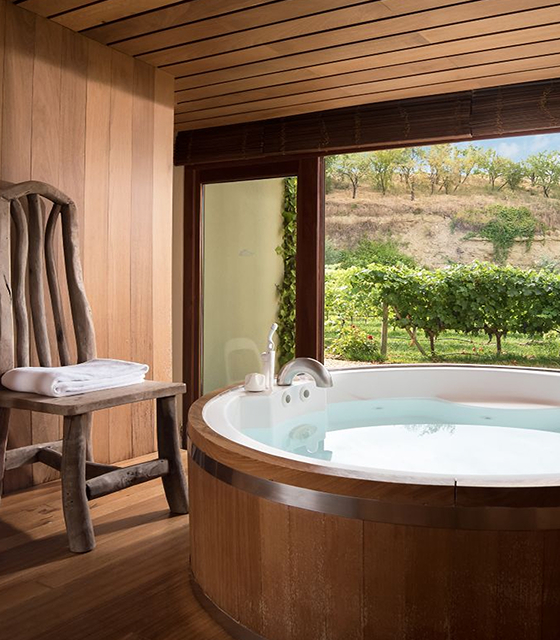
Here, the setting feels completely organic. Cool stone meets warm light, complemented by cedar and teak, to create an utterly seductive space that pleases the senses – all while vineyards peek through panoramic windows stretching across the back wall. Gehry designed this space to touch the soul and harness inner peace, because wellness is never selfish; it is selfless.
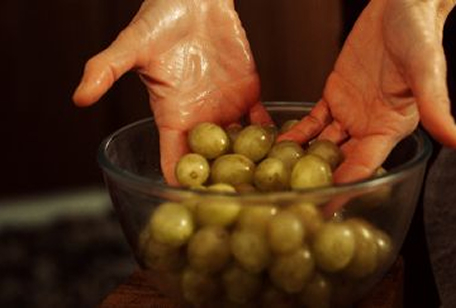
Unsurprisingly, many treatments incorporate grapes – not as a novelty, but for their proven benefits. Partnering with the prestigious French cosmetics brand Caudalie, the spa uses products made from grape pips and pulp to naturally exfoliate and rejuvenate. Recognized worldwide by doctors and surgeons, the vine is rich in antioxidants, polyphenols, and resveratrol, which protect the skin, boost collagen, and improve circulation.
The story began in 1995, when Caudalie’s founders Mathilde and Bertrand Thomas discovered that grape seeds contained some of the most powerful natural antioxidants known, at their family vineyard in Bordeaux. They imagined a sanctuary far from modern distractions but surrounded by vines to create a place where “bodies are soothed and souls are regenerated.” Their vision of Vinothérapie® became a reality in 1999, pairing beauty treatments with the ritual of wine culture – and they haven’t looked back since. Today, there are four spas in the world dedicated to the practice of Vinothérapie®. Marqués de Riscal is one of them – and it’s the only location outside of France.
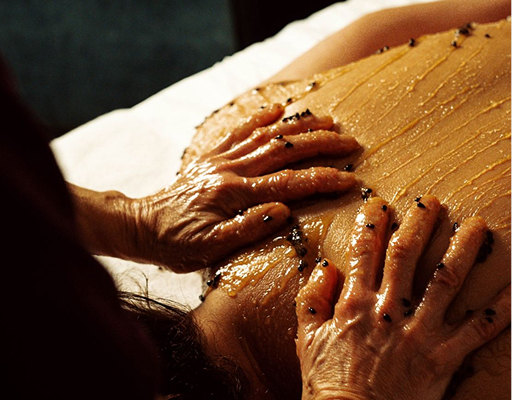
At the hotel’s spa, you can expect indulgent treatments like the Caudalie Grand Facial, a signature treatment that relaxes, restores, and renews to leave your complexion rested and radiant. Or perhaps the Crush Cabernet Scrub, a massage blending grape oil, seeds, honey, and essential oils into your skin leaving it moisturized and smooth. Or even a warm soak in tubs shaped like oak barrels, infused with vine extracts and oils, designed to relax muscles and promote detoxification.
Whichever treatment you choose, you remain connected to nature at every step. It is indulgence and science in harmony – a ritual that leaves you feeling as though the vineyard itself has shared its vitality with you, unfolding like wine: in layers, moments to savor, and a finish that lingers. Like Gehry’s architecture and Riscal’s wines, every treatment is rooted in tradition yet reimagined as something new.
Dare to unwind
Of course, indulgence doesn’t always look like stillness — sometimes it’s found in movement (or in a glass or two of wine).
For those seeking balance and mindfulness, a light-filled yoga studio welcomes both seasoned practitioners and curious beginners. The hotel’s heated indoor pool, lined with black tiles that reflect natural light in dramatic ways, offers a striking place to swim or simply float.
Or step outside and allow nature to add perspective. Bike along winding vineyard paths, past ancient chapels, to the lush banks of the Ebro River. Even a walk through the cobblestone medieval streets of Elciego feels like part of the ritual, reminding you that wellness here is as much about place as it is about practice, where time seems to pause even as it continues to flow.
Wellness here is never one-dimensional. Whether you’re stretching in sunlight, pedaling past vines, or losing yourself in the quiet lanes of Elciego or Gehry’s ribbons, it exists in moments meant to be savored slowly. Everything is done with purpose.
“Some places are remembered for their beauty, others for their history. Marqués de Riscal is unforgettable because it dares you to ask a different question.”
At El Marqués de Riscal, Gehry’s daring design and the vineyard’s centuries of excellence come together to create something singular – a place where art, wine, and life are inseparable. It is a retreat that doesn’t simply offer luxury but dares you to embrace it.
Stay in a Gehry masterpiece? Drink wines crowned the best in the world? Reset at a spa powered by the vineyard? Why not.