When I was a sophomore in college, I had a history professor who completely changed the way I thought about the subject.
Most history classes felt like an endless list of dates, names, and facts you were expected to memorize just long enough to survive a test. His classes felt more like episodes of a really good TV drama.
He told stories. Not “history stories.” Human stories. And we, his students, found ourselves binging world history decades before binging became a thing.
In his classroom, kings, generals, politicians, and ordinary people weren’t names in a textbook. They were characters. They had flaws. They succeeded. They failed. They loved. They worried. And many times, they made spectacularly bad choices.
History wasn’t something that happened. It was something people lived through.
For our final research paper, he gave us an assignment I’ve never forgotten. We had to write in the first person, using actual historical sources, and tell a story. I chose to write from the perspective of a Roman soldier stationed in Pompeii during the eruption of Mount Vesuvius.
Spoiler alert: I didn’t survive. But I did get an A on the paper. (I’m pretty sure I still have it somewhere.)
More importantly, I developed a fascination with Pompeii that stuck with me long after the semester ended.
THE PLACE I NEVER
THOUGHT I’D SEE
For years, Pompeii existed only in books, documentaries, and my imagination. Then, about fifteen years later, my wife and I found ourselves in Rome on our honeymoon. We decided to take a day trip south.
Suddenly, I wasn’t reading about Pompeii anymore. I was standing in it. And it was every bit as incredible as I hoped it would be.
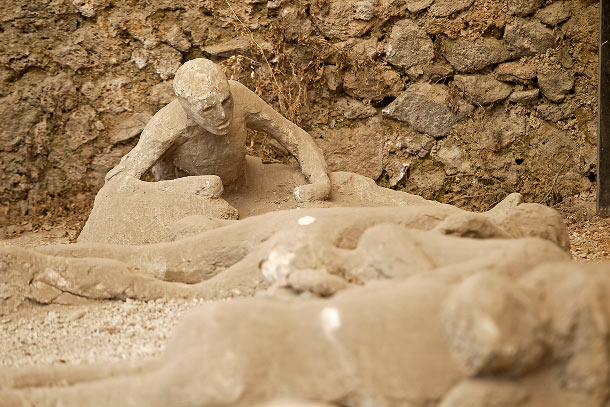
What’s funny is that when people talk about Pompeii, they usually focus on one thing: the casts. Those haunting figures frozen in time. They’re remarkable, of course. And seeing them in person is powerful. But they’re not what I remember most.
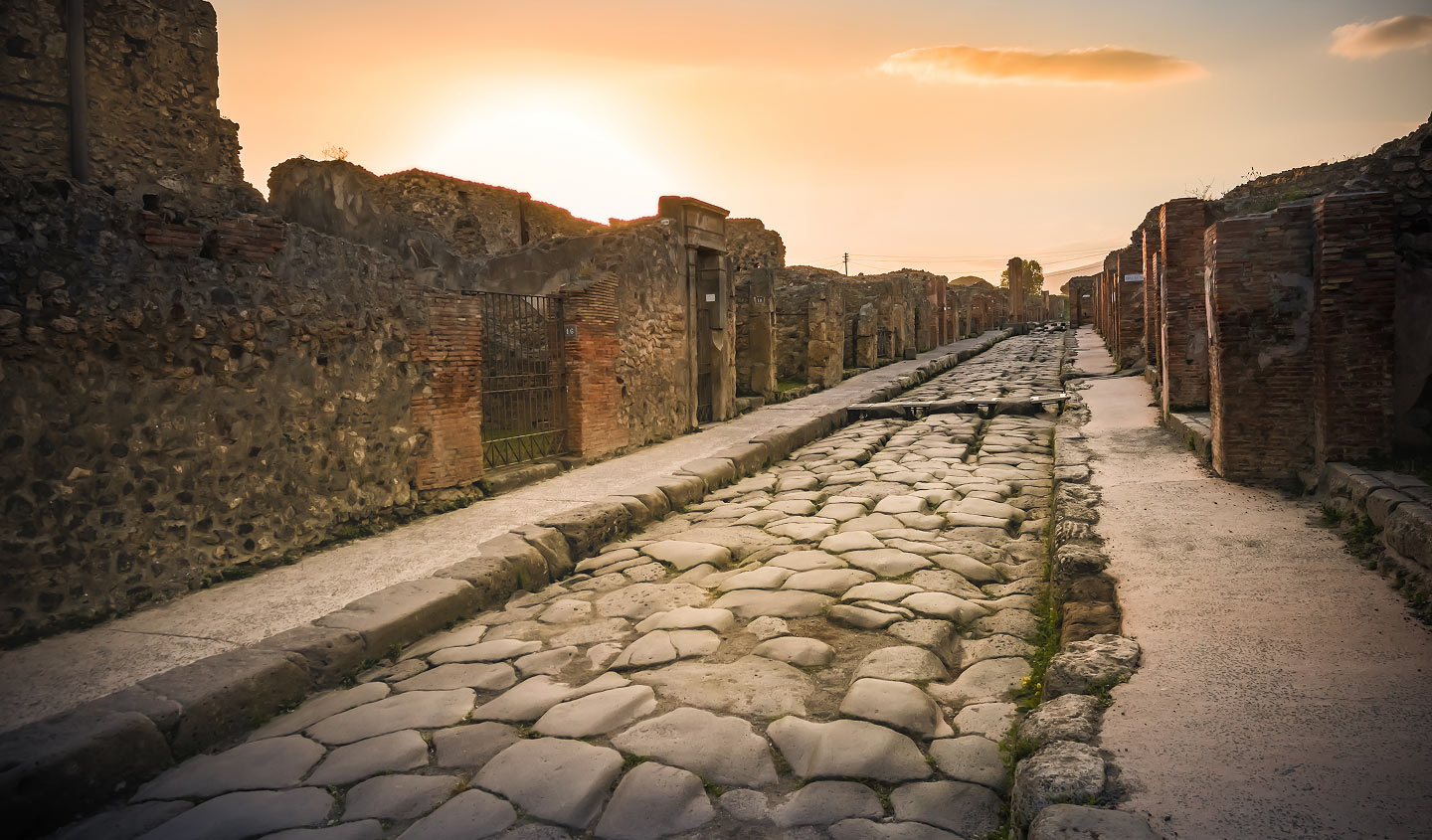
I remember the deep wagon-wheel ruts carved into stone streets by generations of traffic.
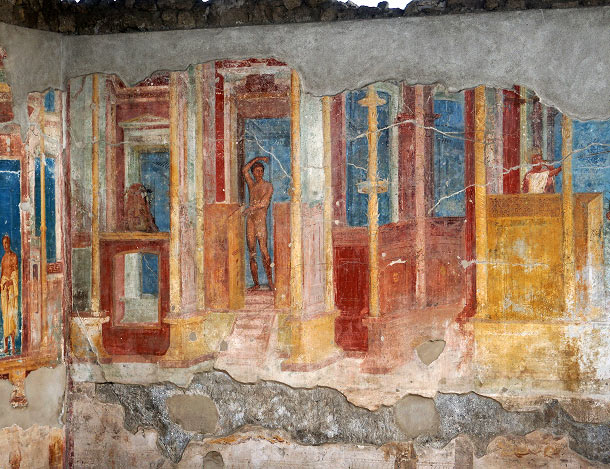
I remember faded paintings that somehow still cling to walls after nearly two thousand years.
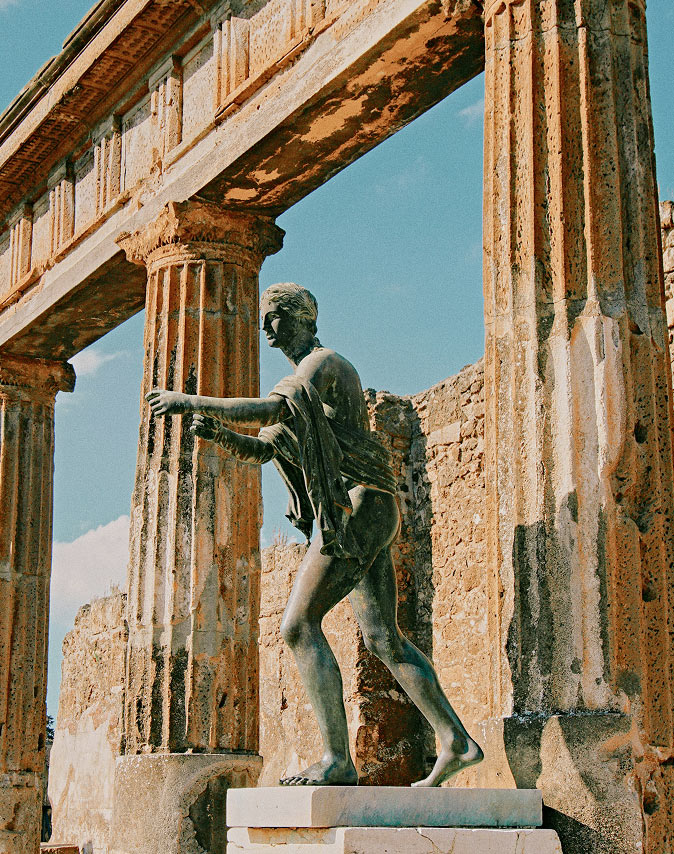
I remember standing where gladiators once trained.
I remember walking through homes and courtyards and realizing that, despite all the centuries between us, the people who lived here weren’t all that different from me.
And I remember Mount Vesuvius. You can see it from just about everywhere. And even now, it feels like it’s watching.
THE STORY MOST PEOPLE
DON’T KNOW
Here’s something many visitors don’t realize.
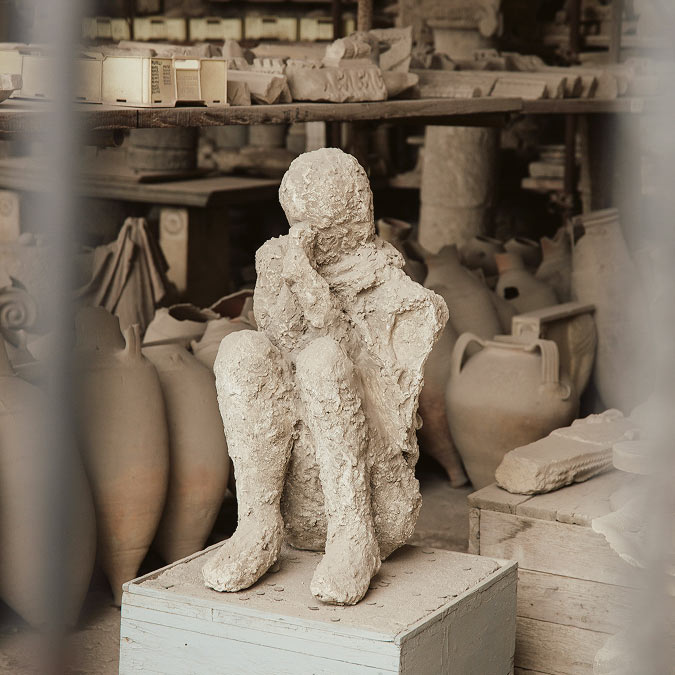
Those famous figures aren’t actually people turned to stone. When Vesuvius erupted in 79 AD, the city – and thousands of its inhabitants – were buried beneath volcanic ash and debris. Over time, the bodies of the victims decomposed, leaving hollow spaces in the hardened ash. Centuries later, archaeologists discovered these voids and carefully filled them with plaster.
What we see today are casts of the spaces people once occupied.
Not the people themselves, but the traces they left behind.
In a strange way, I think that’s even more moving.
LOOKING BEYOND THE SPECTACLE
Pompeii attracts millions of visitors every year. And understandably so. It’s one of the most extraordinary archaeological sites on Earth.
But it’s also easy to reduce it to a spectacle. To focus on the eruption. The tragedy. The dramatic final moments.
The longer you spend there, though, the more you realize that the real story isn’t how Pompeii ended. It’s how Pompeii lived.
The bakery where bread was made. The shops that opened each morning. The homes filled with artwork. The streets crowded with merchants, workers, travelers, and children.
The details are what make Pompeii feel surprisingly emotional. They’re familiar.
History often feels distant because we focus on what makes people different from us. But, when you’re there, Pompeii reminds us how much we actually have in common.
A STORY THAT ISN’T FINISHED YET
One of the most fascinating things about Pompeii is that archaeologists are still uncovering new pieces of the city today.
The story isn’t finished.
On Roam by Tauck’s Rome, Sicily & Malta journey, guests have the rare opportunity to go beyond the areas most visitors see and step into a restricted active excavation zone, where new discoveries continue to emerge from beneath the ash, helping historians better understand what everyday life looked like before the eruption.
It’s a chance to see history while it’s still being revealed. And, for someone who has been fascinated by this place since a college history class decades ago, that’s pretty incredible to think about.
THE TRACES WE LEAVE BEHIND
While I was thinking about what to write for this post and doing a little research, I found myself trying to remember the name of that professor. I’m ashamed to say I couldn’t.
But I did come across an old university article about a beloved history professor who passed away just a few years after I took that class.
I can’t say with complete certainty that it was him. But some details line up in a way that makes me think it probably was. (I actually ordered my transcript to find out for sure – but unfortunately it doesn’t show professors’ names.)
If that’s true, it’s strange to realize that someone whose name had slipped from my memory still managed to shape the way I experience places like Pompeii all these years later.
And maybe that’s why Pompeii still matters.
We don’t know the names of most of the people who lived there. We don’t know what made them laugh. We don’t know what they talked about at dinner.
We don’t know what they planned to do on a tomorrow that never came.
But pieces of them remain. A painting on a wall. A groove in a road. A loaf of bread preserved in ash. A home they loved.
Enough to remind us they were here. Enough to make them impossible to forget.
Professor, I hope you’re resting easy. I wish you could know what an impact your class and that assignment had on me. It was one of the first times I realized I might be able to turn this whole writing thing into a real career. Wherever you are now, just know that your story – like all those stories you told us years ago – lives on.